5 Steps for Brain-Building Serve and Return
This brief guide from the Harvard Center on the Developing Child outlines 5 steps for primary caregivers to practice serve and return with their child.
File
This brief guide from the Harvard Center on the Developing Child outlines 5 steps for primary caregivers to practice serve and return with their child.
The paper describes the findings of a geographical mapping and analysis of residential care facilities in four regions of Ghana.
This study aimed at investigating specifically whether institutionalization impacts negatively children’s psychological adjustment defined in terms of externalizing behavior, internalizing behavior and self-esteem and whether having living parents has additional influence. Ninety-five institutionalized and 82 not institutionalized children in Rwanda, aged 9 to 16, participated in the study.
This paper from the Scottish Journal of Residential Child Care outlines the Child Rescue Centre's process of transitioning from residential care to family-based care in Sierra Leone.
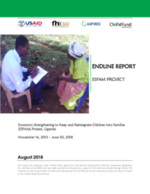
This final report describes the Economic Strengthening to Keep and Reintegrate Children into Families (ESFAM) project and presents findings from an evaluation of the program, including its implementation and outcomes as well as its impacts.
This video presents the work of the FARE family strengthening program in Uganda to prevent separation of families and reintegrate children who are separated from their families, including the story of one young person and his family who were impacted by the program.
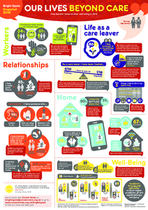
This snapshot summarises the findings from the responses of 474 16-25 year old care leavers who completed the Your Life Beyond Care (YLBC) survey in 6 local authorities in England - an overall response rate of 30%. This snapshot gives an insight into how care leavers really feel about their lives.
This report from the German Youth Institute (Deutsches Jugendinstitut e.V., DJI) assesses the adoption system in the Netherlands.
This mixed method study explores the postsecondary experiences of foster alumni in a large southwest urban area of the US.
This article argues that the US state of Alaska should enact a state statute to provide clear guidance to state child welfare practitioners and state courts that Alaska’s state government recognizes an Indian custodianship created through Tribal law or custom as a pathway for Indian children to exit the overburdened state foster care system.