Displaying 1 - 10 of 698
This narrative review analyzes 161 recent studies across 67 countries on the shift from institutional to family-based care, finding that while most research supports de-institutionalization, it is often limited by small samples, qualitative methods, and weak study designs. It highlights significant evidence gaps and calls for more rigorous, transparent, and replicable research to better inform policy and practice.
This article explores how social welfare officers in Tanzania experience and manage the reintegration of institutionalised orphans back into family care. It examines the strategies they use, the challenges they face, and the broader systems needed to support sustainable, child-centered reintegration.
This podcast explores why many U.S. Christians continue to financially support orphanages despite believing children thrive best in families, highlighting a gap between values and giving behaviors. Drawing on Barna research, it examines misconceptions, emotional drivers, and practical barriers influencing donor choices, while encouraging a shift toward family-based care and more ethical, community-centered engagement.
This report contains the findings from a nationally representative study conducted in 2025 by Barna Group of U.S. Christians to better understand U.S. Christian beliefs around and support for orphanages, children’s homes and other forms of residential care for children.
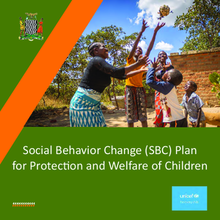
This Social and Behaviour Change (SBC) Plan outlines Zambia’s strategic approach to strengthening child protection through behaviourally informed programming and community engagement. Developed by the Ministry of Community Development and Social Services with support from UNICEF and partners, the plan focuses on reducing violence against children, preventing child marriage, increasing birth registration, and promoting family-based care.
This study examines the early stages of deinstitutionalization in Zimbabwe, finding that progress is hindered by inconsistent processes, limited workforce capacity, and resistance from institutional stakeholders. It highlights the need for clearer guidelines, stronger training, and better support systems to enable effective transitions from institutional to family-based care.
This case study describes how ACE Zambia transitioned from providing residential care in Zambia to pioneering family-based care, including foster care, and supporting other residential care service providers to transition.
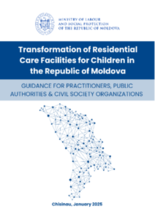
The Moldova Transformation Guidance aims to support the transformation process of residential care facilities (RCF) to models that promote family support and community-based services, or to safely close them and redirect their resources. National and local authorities can use this guidance to design, plan, budget, communicate, and coordinate transformation at both individual and system levels.