Representation of Care Leaving and Care Leavers in Media Discourse: A Polish Study
The presented analyses aim at depicting social discourse concerning the process of care leaving.
The aim of this paper is to indicate threats and possibilities as regards the functioning of the foster care system and the process of adult care leavers’ gaining independence.
Through careful ethnography and rich in-depth interviews at a non-profit foster care agency, this book takes a look behind the scenes of the U.S. foster care system.
The objective of this study was twofold: to explicate how a culturally adapted parent training (PT) intervention for diverse families involved in child welfare services (CSW) was perceived by participants and to better understand how interventionists adapted to families’ needs.
This article analyzes developments in the forms of social work with young refugees and the legal framing of such work in Germany from 1990 to the present.
This book outlines the nature of contemporary children’s care sector in England, highlighting both the demographics of those currently in care and the nature of available provision. It provides an account of the issues facing children and young people in care in terms of their vulnerability to criminalisation and exploitation.
This policy analysis examines the impact of COVID-19 policy guidance on the role of workers who provide outreach to transition-age care leavers.
This article focuses on the lived experiences of orphaned learners and their perspectives relating to the support offered by the School-Based Support Team (SBST) within schools, in two education districts of the Free State province, South Africa.
In line with recent policy discussions on mechanisms to regulate informal kinship care practices, this study aimed to identify how the State could be involved in improving kinship care experience for children.
This paper examines the effects of Human Rights Education (HRE) on youth in the impoverished community of Trevo in Mozambique, particularly orphans and vulnerable youth.
This study investigates the extent and causes of child abandonment and various practices and services in relation to prevention of child abandonment in Denmark and other high-income countries.
This study aims to explore the experiences of Ghanaian care leavers to discern the factors that promote and impede their educational attainment.
This article describes the benefits of monthly family team meetings for parents involved with child welfare. Findings are shared from semi‐structured, qualitative interviews conducted with 17 parents whose children had been placed in substitute care.
This paper summarises the findings of three years of work by the UK Children’s Commissioner’s Office and provides context for two further reports. It explains the failure of local and national government to take responsibility for children in residential care and sets out what action is needed by government – both local and national – to fix this broken system.
The OVCMIS is one of the key instruments for effecting implementation of the National Strategic Programme Plan of Interventions for orphans and other vulnerable children (NSPPI).
This assessment toolkit and associated supporting documentation has been created to assist PSWO’s and Child Care Institutions to achieve compliance with the Children (Approved Home) Regulation 2010.
The purpose of this manual is to provide guidance on how to collect and report data on children in formal alternative care in a standardised way, and to analyse, present, and make the data available for use.
The overall goal of “Harnessing the Power of Data for the Benefit of the Child” activity—implemented by D4I in the Republic of Moldova—is to strengthen the capacity of the government and its partners at national and subnational levels to collect, analyze, and use data to generate a positive impact on children in adversity.
The aim of this Handbook is to help to standardize practice in child protection case management in Uganda.
These Guidelines are for all persons taking care of children. The goal of these Guidelines is to empower parents, the family and community structures to effectively nurture children so that they can realise their full potential.
This is a National Guide for the participation of children which has been developed in consonance with Art. 12 of the United Nations Convention on the Rights of the Child (UN CRC).
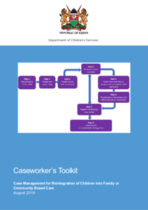
This harmonised Case Management (CM) toolkit includes standard operating procedures describing how each step of the CM process should be implemented, tools or forms that should be used for CM, and additional guidance that must be taken into account by actors involved in CM.
The study examined alternative family and community care options and how they can be strengthened; cultural attitudes and perceptions of the communities and experiences of prospective foster and adoptive parents as regards reunification, kinship care, fostering and adoption.
This study is purposely looking at issues around institutionalization and the experiences of resettled youth resulting from the social and economic challenges that affect them in independent living, tackling how they are negotiating and overcoming them.
Focussing on Sheema district in rural Uganda, this study sought to give voice to ‘OVC’ and use their lived experiences to develop a robust framework of care and support.