Memoria de Labores 2019
El Consejo Nacional de Adopciones se presenta al público en general la Memoria de Labores correspondiente al 2019, en la cual el único compromiso fue restituir los derechos de la niñez guatemalteca.
File
El Consejo Nacional de Adopciones se presenta al público en general la Memoria de Labores correspondiente al 2019, en la cual el único compromiso fue restituir los derechos de la niñez guatemalteca.
La presente ley tiene por objeto crear y regular el Sistema Nacional de Protección
Integral de la Niñez y Adolescencia.
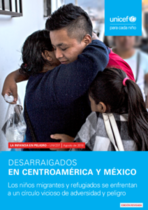
En este informe de la Infancia en peligro se evalúan las causas estructurales de las migraciones irregulares procedentes del norte de Centroamérica y México, y se analizan las distintas dificultades y peligros a los que se enfrentan los niños migrantes y refugiados y sus familias durante los arduos procesos de migración y retorno.
El informe tiene como propósito presentar a las autoridades gubernamentales, no gubernamentales, agencias de cooperación internacional, medios de comunicación social, instituciones académicas, centros de investigación y población en general, los resultados obtenidos que muestran las condiciones de salud reproductiva, salud materno infantil y para los demás temas incluidos en la encuesta.
Este reglamento tiene por objeto adecuar la práctica judicial al sistema de protección integral de niñez y adolescencia, en la aplicación de medidas de protección y abrigo provisional de niños privados de su medio familiar.
El presente reglamento tiene como objeto desarrollar los procedimientos técnicos y administrativos que realiza la Procuraduría de la Niñez y la Adolescencia y sus Delegaciones Regionales en cada una de las materias que la Ley de Protección Integral de la Niñez y la Adolescencia y otros cuerpos legales le asignan.
The State of Uganda Population Report 2019 shows the potential of social protection systems to promote inclusive development that leaves no one behind—to reduce poverty, inequality and promote social inclusion.
The sections in this report provide an analysis of Uganda’s disability policy and legislative framework and how it is implemented, and emphasizes the need for sound research for development, including statistics.
This study assessed child poverty, deprivation and social service delivery in refugee and host communities in selected districts in the country’s three major refugee-hosting areas: West Nile, a sub-region of Northern region that borders South Sudan; the country’s South West, which borders the DRC and Rwanda; and the capital, Kampala.
This article sets out some of the evidence of the impact of institutionalisation on children in Europe.
This document contains a list of alternative care homes in Uganda that have been approved by the Ministry for Gender, Labour and Social Development.
The study described in this report set out to identify and systematically learn about the functioning of existing community-based child protection mechanisms in Aceh, Indonesia.
This Note provides background and technical information on social protection in Cambodia to inform the development of a national social protection strategy for the poor and vulnerable by the Council for Agricultural and Rural Development (CARD).
This article analyses the interactions among global and national actors in the policy dynamics of Cambodia’s National Social Protection Strategy (NSPS); it is intended to disentangle the complex politics of global social policy at the national level.
This publication proposes a framework of core indicators for measuring and monitoring national child protection systems in the East Asia and Pacific region.
This discussion paper puts forward a set of lessons learned and recommendations for referral mechanisms and case management for vulnerable children in the Eastern and Southern Africa region (ESAR).
Este trabajo pretende identificar los principales problemas que enfrentan los países de la región en relación al tema y desarrolla someramente algunos de los estándares de derechos humanos que deben ser observados, con el objetivo de contribuir sustancialmente a la adecuación de los sistemas de protección en lo que refiere a la utilización de la internación de los niños, niñas y adolescentes en las instituciones de protección.
In this short editorial, the organization New Beginnings shares the stories of three of the families they work with who have wanted to explain what lockdown has meant for them during this peculiar time.
The report presents an overview of the Situation of Children and Women in Kenya using the results of the most significant research and analysis between 2014 and 2017 in areas related to the wellbeing of children and women.
The purpose of this study was to investigate the extent to which government allocated financial resources, management procedures and stakeholders are major determinants of implementation of cash transfer program for orphans and vulnerable children in Isiolo County, Kenya.
In 2011/12 a comprehensive Review was undertaken of Kenya’s Social Protection Sector. This Review follows up on progress made since the previous one.
This report provides insights into the current situation in Kenya regarding the inclusivity of social protection for people with disabilities.
This publication is presented in three parts. Part 1 discusses how seeing Haitian children as part of a complex and beautiful social system can inform best practices in child care reform. Part 2 highlights eight organizations working towards family-based care and the preservation of families and communities. Part 3 provides inspiration for collective action and transformation.