
File
Displaying 1 - 10 of 77
Join the Children's Commissioner, Dr Claire Achmad and Leon Tan of the Children's Rights Alliance Aotearoa New Zealand for a fireside conversation exploring what it could mean to "bring home" the promise of children's rights through incorporation of the United Nations Convention on the Rights of the Child 1989 (UNCRC) into domestic law.
This article explores how out-of-home care systems across five countries (Australia, Canada, New Zealand, United Kingdom, and the United States) approach cultural care for children, examining the organisational structures, leadership, and practices that support or hinder children’s connections to their culture, family, and community. Drawing on interviews with service providers, it highlights key drivers of effective practice and offers practical tools and insights for strengthening culturally responsive, system-wide approaches to safeguarding children’s identity and wellbeing.
This article reports that New Zealand’s Child Protection Investigation Unit—established to investigate serious harm to children in state care and identify systemic failures—is being significantly hindered by poor information-sharing between government agencies and partner organizations. Internal reports reveal that delays, limited access to critical data, and lack of visibility into other agencies’ work have slowed investigations and risk undermining the unit’s effectiveness and impact.
This article examines how child protection systems continue to reflect colonial power by disproportionately intervening in Indigenous families and undermining cultural practices and kinship systems. It highlights growing Indigenous-led movements to reclaim authority over child welfare, emphasizing self-determination and the rebuilding of care systems grounded in Indigenous laws, values, and relationships.
This article explores the parenting support needs of young mothers in Aotearoa New Zealand who grew up in out-of-home care, highlighting how their childhood experiences shape their access to and perceptions of support. It finds that these mothers face significant barriers and fears in engaging with services, underscoring the need for specialized, independent parenting support as part of after-care.
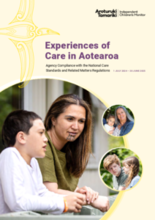
The New Zealand National Care Standards (NCS) Regulations came into effect in 2019, and set out the minimum standard of care that must be provided when the state has custody of a child. This is Oranga Tamariki's fifth report on compliance with the NCS Regulations. It finds that children and youth are still not receiving the minimum standard of care required by the NCS Regulations.
This article highlights New Zealand’s kinship care movement, where relatives or close family friends step in to care for children when parents are unable to.
This report presents findings from a small-scale qualitative study commissioned by Family for Every Child, examining how kinship care is understood and experienced in Aotearoa New Zealand. It explores the challenges faced by kinship carers and their support needs.
The article reports that New Zealand has temporarily suspended recognition of many international adoptions — especially those from Samoa — citing concerns over cases of abuse after children adopted overseas arrived in New Zealand.
After last year’s budget cuts to social services, including a NZ$14 million cut to early home visits, social services providers in New Zealand raised concerns about what the move would mean for children and families needing support.