Virtual Case Management Monitoring Guidance and Tracker
This guidance was developed to support case workers to conduct virtual monitoring of children and families within their caseload throughout the COVID-19 pandemic.
This guidance was developed to support case workers to conduct virtual monitoring of children and families within their caseload throughout the COVID-19 pandemic.
Este documento presenta recomendaciones para garantizar que los procedimientos del mecanismo de prevención de la institucionalización continúen siendo efectivos o, en algunos casos, se fortalezcan durante la pandemia de la COVID-19.
Esta guía debe considerarse para: niños, niñas y adolescentes que actualmente viven en un entorno de protección residencial, lo cual incluye a aquellos que han sido colocados antes y después del inicio de la pandemia de COVID-19.
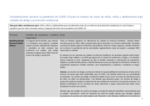
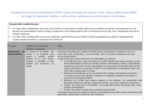
Esta guía debe considerarse para los niños, niñas y adolescentes que viven con su familia que puede estar en una situación de vulnerabilidad o estar en riesgo de separación y también los niños, niñas o adolescentes que se han reunificado recientemente con sus familias, incluidos aquellos(as) que salieron rápidamente del cuidado residencial debido a la pandemia de la COVID-19.
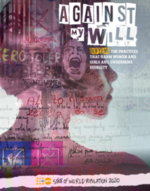
This report from UNFPA explores harmful practices affecting women and girls around the world, focusing on three particular practices: female genital mutilation (FGM), child marriage, and son preference.
In this video, Grace Mwangi shares key lessons from her experience working in community-based social work with children and families at risk of separation in Kenya.
In this webinar hosted by Better Care Network and the Consortium for Street Children, speakers from three NGOs presented on and discussed the care implications of COVID-19 and responses to the pandemic on street-affected children.
This document sets out the draft advocacy messages and recommendations for donors, governments, and civil society, which were prioritised by participants of the December 2019 Learning Session co-hosted by the Coalition for Children Affected by AIDS and the World Health Organization to develop an evidence-informed advocacy agenda on adolescent mothers affected by HIV and their children.
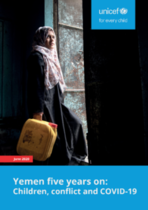
This report from UNICEF explores the situation of children during the humanitarian crisis in Yemen, including the impacts of the COVID-19 pandemic. It outlines UNICEF's response to the crisis and presents a global call to action.
This article explores the significant emotional and physical health needs of unaccompanied asylum-seeking children in the European Union, recommending a stepwise approach to delivery of services so as not to overwhelm them.
This study investigated process and outcomes of the Parenting for Lifelong Health (PLH) for Young Children and for Adolescents programs implemented as part of routine service delivery in postconflict settings.
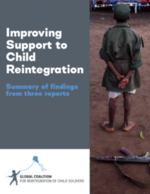
This document is a summary of three papers on how to effectively support children who have exited armed forces and armed groups and contains actionable recommendations at the end to stimulate thinking and action to assist these most vulnerable children and their communities.
For this study, semi-structured interviews with twelve birth parents and twenty six permanent carers took place in New South Wales, Australia. Inductive thematic analysis was used to identify a pattern in the nature of adult relationships. The themes of 1) getting to know each other; 2) making family time; and 3) a shared future are presented.
The purpose of this study was to examine whether eliminating variation in information presented to multi-disciplinary teams eliminates variation in the proportion accepted for a child protection alert.
The purpose of this paper is to critically reflect on the conditions and context of deinstitutionalization and the process of transformation of the institutions for children with behavioural problems from several key aspects: current offer of treatment programs and interventions in institutions and communities, competences of professionals in transformation process, research related to needs and risks of children and education of future professionals.
Se ha desarrollado la presente herramienta de indicadores a fines de poder contar con un instrumento de medición y evaluación del nivel de progreso alcanzado en cada país respecto de los sistemas nacionales de protección de la niñez.
The 2020 Global Education Monitoring Report recognizes the contexts and challenges facing countries in providing inclusive education; the groups at risk of being excluded from education and the barriers individual learners face, especially when various characteristics intersect; and the fact that exclusion can be physical, social (in interpersonal and group relations), psychological and systemic.
In this brief, John H. Laub and Ron Haskins suggest a number of policies that could help children with incarcerated parents and children in foster care.
In this article, developmental psychologists Ariel Kalil and Rebecca Ryan examine the relation between parenting practices and socioeconomic gaps in child outcomes.
This webinar includes presentations from panelists in Latin America discussing early childhood programming in the region, particularly in light of the COVID-19 pandemic.
To explore the complex dynamics of parental migration on nonsuicidal self‐injury (NSSI), this study examined the roles of parent–child cohesion and socioeconomic status (SES) in the relationship between stressful life events and NSSI.
This review provides an overview and educational material on nonaccidental injury (NAI) and its clinical presentation.
The purpose of this article is to discuss whether adoption, in the form in which it is systematized in Brazil, by the National Adoption Register, may be the solution to the serious problem of child and adolescent in risky situations of care, especially those living in the state of Rio de Janeiro.