
Displaying 761 - 770 of 1116
This independent report, from University of Bristol and Durham University, draws on information from the largest randomised controlled trial of a service for children affected by sexual abuse.
This country care review includes the care-related Concluding Observations adopted by the Committee on the Rights of the Child.
The CDC released a groundbreaking report that estimates the global burden of violence against children under 18 for each region of the world. This report is entitled “Global Prevalence of Past-Year Violence Against Children: A Systematic Review and Minimum Estimates,” and it combines data from 38 reports covering 96 countries.
The global plan of action is a technical document informed by evidence, best practices and existing WHO technical guidance.
This study is a snapshot of a multi-country study involving Italy, Peru, Viet Nam, and Zimbabwe of how individual characteristics, interpersonal relationships, and the communities in which people live interact with institutional drivers to increase or reduce a child’s risk of violence.

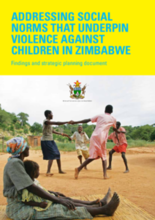
This report highlights key findings from a social norms study conducted in Zimbabwe to understand the drivers of violence affecting children.
This booklet is based on a recent internal desk review of Save the Children’s and partners’ work against physical and humiliating punishment of children, commissioned by Save the Children Sweden. It aims to present best practices, to show what methods have worked around the world, and to spread knowledge about results achieved and lessons learned when it comes to law reform and positive discipline.

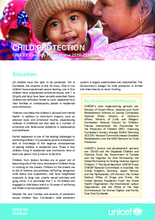
This brief from UNICEF Cambodia describes UNICEF's plans and programs regarding child protection.
This chapter from the book The United Nations Convention on the Rights of the Child: Taking Stock after 25 Years and Looking Ahead, presents the legal framework and public policies that address violence against children in ten South American countries.
This thesis study evaluates the fidelity of a rural Court-Appointed Special Advocate (CASA) program in Georgia, USA. The CASA program trains volunteers to serve as special legal representation for children in the court system who have been abused or neglected.