
Displaying 771 - 780 of 1116
This systematic review evaluated the effect of kinship care placement compared to foster care placement on the safety, permanency, and well-being of children removed from the home for maltreatment.
On 10 December 2015, the Peruvian Congress approved by a near unanimous vote the Law prohibiting the use of physical and other humiliating punishment against children and adolescents (“Ley que prohibie el uso del castigo físico y humillante contra los niños, niñas y adolescents”).
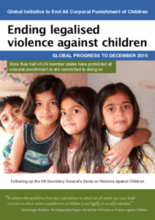
The report discusses progress made towards universal prohibition of corporal punishment of children, including by highlighting examples from individual states that have recently implemented legal and policy reforms. The report also considers prohibition and elimination of corporal punishment in the context of the new Sustainable Development Goals, and discusses initiatives by religious leaders and members of faith-based communities and organisations that are increasingly taking action towards prohibition and elimination of corporal punishment. Lastly, the report discusses the latest research relating to corporal punishment.
Concerned by the protection risks faced by women and girls, the United Nations Refugee Agency (UNHCR), the United Nations Population Fund (UNFPA) and the Women’s Refugee Commission (WRC) undertook a joint seven-day assessment mission to Greece and the former Yugoslav Republic of Macedonia in November 2015. This report describes the assessment’s findings and key recommendations for the European Union (EU), transit and destination country governments, humanitarian actors and civil society organizations (CSOs).
There are compelling reasons to believe that orphans – many millions due to the AIDS epidemic – are more likely to be sexually victimized during childhood.
This study from Singapore examined the association of two factors — children's strengths and placement type, with outcomes at two time-points during out-of-home care.
In this letter to the editor, the authors express their support for the continued use of “baby hatches” in China.
This country care review includes the care related Concluding Observations adopted by the Committee on the Rights of the Child.
This country care review includes the care-related Concluding Observations adopted by the Committee on the Rights of the Child.
This country care review includes the care related Concluding Observations adopted by the Committee on the Rights of the Child.