Displaying 701 - 710 of 999
This review seeks to identify and summarise findings from literature about the nature of relationships that develop between older children and young people, and those caring for them within and beyond residential and fostering settings.
For this study, physical and mental health, school achievement, justice involvement and child protection contact were explored for three cohorts of children in Australia born between 1 January 1990 and 30 June 1995.

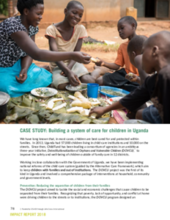
This case study from ChildFund's 2018 Impact Report describes the Deinstitutionalization of Orphans and Vulnerable Children (DOVCU) initiative in Uganda, which aims to to improve the safety and well-being of children outside of family care.
The aim of this report from SOS Children's Villages is to increase the knowledge and understanding of the needs and rights of young people ageing out of alternative care around the world, in order to inform strategies, policies and services to improve their life chances and outcomes through appropriate preparation for leaving care as well as after-care support.
This dissertation was an ethnographic narrative study tracking eight young women who were “aging out” or forced to leave their orphanage in Peru, where most of them had spent a majority of their lives. The study examined the way in which a collaborative art community could support the participants as they narrated their lives over a 16-month period of time through photojournaling and social media outlets.
This is the second briefing paper published as part of the Howard League’s two-year programme to end the criminalisation of children in residential care. It explores how good practice in the policing of children’s homes can significantly reduce the unnecessary criminalisation of vulnerable children and demand on police resources.
This six-part video series provides an overview of the United States National Youth in Transition Database (NYTD) and the NYTD Review, a federal review conducted by the Children’s Bureau to assess how states collect and report data on youth transitioning out of foster care.


This brief article will outline the path to the provision of an explicit entitlement to aftercare in Ireland.
The aim of this study has been to assess the reasons for the increased enrolment of children into orphanages and child care centres. An action research was conducted in Islamabad and Rawalpindi between November and December 2017 to assess the situation and identify the causes and circumstance that bring in and compel orphans and vulnerable children to move out after a certain age or grade.

This study explores the childhood experiences and transitions to adulthood of 39 Romanian care leavers and adoptees, born around 1989 - 1990.