Review of Alternative Care in Thailand: Policy to Implementation with Special Focus on Children Affected by HIV/AIDS (CABA)
01 May 2015
Displaying 91 - 100 of 103
UNICEF Thailand Country Office is seeking a qualified institution to conduct a Review of Alternative Care in Thailand: Policy to Practice with special focus on Children Affected by HIV/AIDS (CABA).
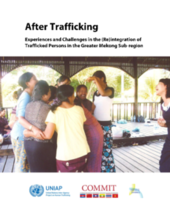
This study, coordinated by the United Nations Inter-agency Project on Human Trafficking, draws findings from in-depth interviews with 252 trafficked persons about their experiences of (re)integration, including successes and challenges, as well as future plans and aspirations.
This revised report presents findings from an evaluation of the Child Protection Monitoring and Response System (CPMRS) in Thailand for the period 2006-2012.
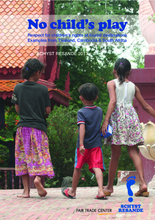
This report was commissioned by the Swedish network Schyst Resande and conducted by the Fair Trade Center, with the overall objective of raising awareness of children’s rights in relation to tourism and travel destinations which many Swedish tourists visit.
With particular attention to lower income countries, Families, Not Orphanages examines the mismatch between children’s needs and the realities and long-term effects of residential institutions.
This document is intended to provide concrete advice on how to put the guiding principles common to most child protection actors into practice. Though cultural traditions and customs may require the advice to be adapted to the specific context, the authors believe that the advice provided is grounded in sufficiently broad experience to guide measures that ensure children under five are not separated when this can be avoided, and, if separated, can be reunited with their families as quickly as possible.

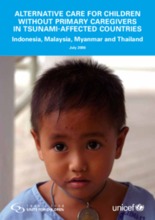
An assessment of alternative care responses for children without primary caregivers in tsunami-affected regions of Malaysia, Myanmar, Indonesia, and Thailand. Includes good practices, recommendations, and detailed country reports.
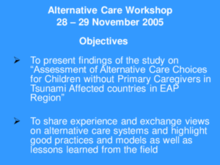
This presentation was given at the Alternative Care Workshop in Bangkok in November 2005.
This presentation includes the objectives and agenda from an Alternative Care Workshop held in Bangkok in November 2005 to present findings from a study on alternative care choices for children affected by the Tsunami in South East Asia and to share experiences and best practices related to children's care.