File
Displaying 651 - 660 of 1206
This chapter from the book Leaving Care and the Transition to Adulthood explores progress towards realizing the rights of young people in and leaving out of home care in Australia, Sweden and the UK.
Family for Every Child is looking for a Knowledge Management Coordinator to strengthen the Alliance’s capacity to transform information into knowledge, which both informs their own joint work and is used to evidence impact, and influence others.
This study aims to explore how care is perceived and practiced among Looked after children and care leavers (LACCL) and those with a duty of care for them.
Drawing on original documentary research, this article aims to explain why and how state authorities in England and Wales failed to recognise the victimisation of children held in penal institutions between 1960 and 1990, and argues that this failure constitutes a disavowal of the state’s responsibility.
The authors of this article reflect on the recently published Care Crisis Review 2018, a sector‐led review, which examines the reasons for the rise in care proceedings and the number of children in care.
This open access paper reports on experiences and reflections of a group of children and young people and academic researchers who developed a Patient and Public Involvement (PPI) group that was set up in the context of an ongoing health service intervention trial with Looked after children and care leavers (denoted as LAC).
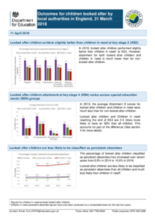
This statistical release provides national and local authority (LA) level information on the outcomes for children who have been looked after continuously for at least 12 months at 31 March 2018, by local authorities in England.
This study uses a randomised controlled trial to examine the impact of Family Group Conferencing on caseworkers’ perceptions of families’ levels of social support.
Empirical research with social workers exploring their understandings and use of codes or ethical theories in practice remain underdeveloped in the UK. This article, based on the British Association of Social Work commissioned Enquiry into the role of the social worker in adoption with a focus on ethics and human rights, provides an important contribution in this context.
The main argument in this article is that the rationale for the state’s growing interest in children (in particular those children who are considered a social problem) and the emerging social policy solutions, i.e., foster care, are driven by particular political and economic agendas which have historically paid little attention to the needs of these children and young people.