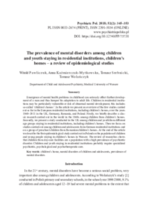
Displaced: On the Road to Somewhere - Why ending violence against children on the move is possible
The aim of this report is to contribute to finding solutions to ending violence against children on the move.
File
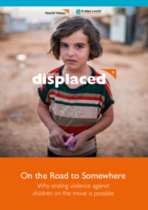
The aim of this report is to contribute to finding solutions to ending violence against children on the move.
This paper examines the My Life, My Future programme that was set up to boost the emotional wellbeing and resilience of looked-after young people.
The objective of this study is to look at attachment styles of children in foster care and how the foster carer contributes to the reparation of insecure attachment of children in foster care.
In this study, the authors used a two-year Texas foster care entry cohort to examine the extent to which children experience “progress moves”, such as moving to a sibling placement or to live with a relative, versus non-progress moves, such as moving due to risk of abuse.
This comprehensive and authoritative book provides an accessible account of attachment concepts. It traces the pathways of secure and insecure patterns from birth to adulthood, exploring the impact of past experiences of abuse, neglect and separation on children’s behaviour in foster and adoptive families.
This project explores storytelling tools for the collaborative work with persons in vulnerable situation, in this case, a group of unaccompanied minors from Afghanistan living in Umeå, Sweden.

This study aims to develop a model for practice for implementing emergency child protection interventions with children at risk.
This study examines how a child welfare agency implemented an innovative pilot initiative designed to promote timely family reunification.
The objective of this study is to identify distinct patterns of care history by applying sequence analysis methods to longitudinal, administrative data.
This bulletin highlights supports and services for kinship caregivers, training for caseworkers and caregivers, and examples of successful kinship care programs.
This synthesis from the U.S. Children's Bureau summarizes the work and findings of a cluster of demonstration projects aimed at developing replicable models of systemic change and evidence-based models for placing children and youth with families who could provide permanent family connections.
This study investigated caregiver-initiated contacts to a statewide, phone-based adoption support program to understand the breadth and range of challenges families experienced during the post-adoption period.
The present study investigated: (a) rates of co-occurrence of pre-adoptive child sexual abuse (CSA) and maltreatment among adopted children, and (b) the relative impact of pre-adoptive CSA and maltreatment on externalizing behaviors at 14 years post-adoption.
This article examines child well-being among African American adolescents in care—a group that is overrepresented within the foster care system. Specific attention is given to relational permanence—the concept of continuous supportive relationships marked by mutual trust and respect.
This "Statement of the Evidence" from the Society for Research in Child Development presents the evidence on the harmful impacts of family separation.
The ideas and questions raised in this chapter derive from the referrals of children in care or adopted whom the author has seen for psychotherapy.
This chapter explores the idea of belonging through the lens of attachment theory.
This study explores the experiences of Jamaican transnational mothers in New York City and documents their stories in light of current research which investigates how transnational motherhood transgresses gender stereotypes and pushes the boundaries of gender roles and expectations.
This publication from the Scottish government examines 2016/17 data on looked after children’s attainment, post-school destinations, school attendance, school exclusions and achievement of curriculum for excellence attainment levels.

This article discusses the use of professional theories in the field of residential child care.
This Comment will look first at the mechanics behind rehoming—what it is and where it fits into the legal framework of the child welfare system. Next, it will look at the causes of rehoming, focusing specifically on how trauma in a child’s background can create a need for specialized training techniques. Lastly, it will look at other states’ legislation to combat rehoming and suggest different areas where Texas can improve its child welfare laws to both prevent and deter rehoming.

The present quantitative study of adolescents in orphanages in South Korea explored the following questions: (1) Do adolescents in institutions experience cognitions and feelings about birth parent loss? (2) What is the association between birth parent loss and mental health (depression, trauma), behavior problems (YSR total internalizing, externalizing), and school problems (school engagement, grades)?

This report from UNICEF assesses the world’s performance towards meeting the 2030 Sustainable Development Goals (SDGs) to date, focusing on 44 indicators that directly concern 2030’s most important constituency: children.
This page from the Human Rights Campaign provides a list of resources for child welfare professionals working with LGBTQ youth and families.
This chapter briefly outlines the range of assessments that are undertaken by psychologists in regards to placements for children in care, and underlines the importance of drawing together information about the child from different sources and perspectives.
The chapters in this book discuss the complexity immediately encountered when approaching the task of improving the lives of Looked After Children (LAC).
This narrative documents the experience of researchers with the objective of documenting lessons learned in the Amajuba Child Health and Wellbeing Research Project, a collaboration between researchers from two universities and a community in South Africa which measured the impact of orphaning due to HIV/AIDS on South African households between 2004 and 2007.
This study aimed to determine whether parents with two generations of involvement in out-of-home care (themselves as children, and their own children) are at increased risk of death by suicide than parents with no involvement or parents with one generation of involvement in out-of-home care.
This chapter will critically examine the difficulties faced by young people who are looked after by local authorities in accessing mental health services and argue, based on findings of recent Serious Case Reviews that there has never been a more dangerous time to be a looked-after child.
This case study follows a foster teen's matriculation through high school and the challenges she faces while trying to achieve her dream of going to college.
This paper describes the experiences of parents with child welfare cases in family court. The paper argues the need to build a court process to support parents and keep families together.
This paper outlines key findings from the first comprehensive study of permanence planning in Scotland.
This report from the UN Special Rapporteur on the right of everyone to the enjoyment of the highest attainable standard of physical and mental health calls for an end to the use of detention and confinement as a tool "to promote public safety, “morals” and public health."
This working paper is based on findings discussed in the project report CURANT: a first evaluation report (Ravn et al., 2018), which focuses on the first impressions and experiences of the young refugees and their local buddies, who entered the project during its first year of implementation.
This comment will argue that unaccompanied alien children have a due process right to appointed counsel at the government’s expense.
This thesis took on a meta-analytical approach to examine sources of heterogeneity between studies evaluating the effect of foster care on adaptive functioning, cognitive functioning, externalizing behavior, internalizing behavior, and total problems behavior.
This research study proposes to explore aggregate of factors responsible for the academic struggles of foster care youth.
This article examines the positive and negative ways in which media affect the processes of out-going adoption from the U. S. and disrupted adoption.
The aim of this paper is to define social and psychological problems faced by children of unknown parentage in foster families in the governorate of Muscat, Oman.
This guide is intended to equip State, Tribal, and Territorial child welfare managers and administrators — as well as family support organizations — with current information about effective strategies for developing data-driven family support services and research findings to help them make the case for implementing and sustaining these services.

This bulletin draws from available literature and practice knowledge to summarize key issues related to providing effective services to support the stability and permanency of adoptions.
This dissertation is composed of four papers. It builds on the postcolonial and post-development theories to provide a critical and a multifaceted approach to understand volunteer tourism as a poverty business.
In this paper, the authors outline key findings about the educational attainment of children and young people in care as identified by national and international research on this topic.
This article examines the case of three groups of young people in Filipino transnational families: stay-behind children of migrant parents, migrant children reunited with their parents in their receiving country, and children of ‘mixed’ couples.
The aim of this chapter is to explore how caregiving arrangements among parents of the recent East European labour migrants in Sweden develop in a transnational setting.
Based on ongoing qualitative research conducted with migrant families in Switzerland, this paper builds on empirical data gathered through interviews with both migrants and their G0 parents, from EU (France, Italy, Germany, Romania and Portugal) and non-EU countries (Brazil and North-African).
In this introductory chapter of the International Perspectives on Migration book series, the authors offer an overview on some of the book’s main topics – such as transnational care, childhood and parenthood, transnational spaces and temporality, – aiming to offer a coherent picture of the issues therein from a synchretic, however problematic, point of view.
The paper aims at contributing to the knowledge and understanding of growing up transnationally and ‘doing transnational family’ between China and Hungary. It has a special focus on mobile childhoods in transnational families and links specific childcare-related phenomena with the process of the integration of second generation migrants.
The authors of this article have started to conduct a qualitative research intending to determine, if and to which extent, children left behind are vulnerable to human trafficking.
This article presents an overview of the few studies carried out so far in the European residential institutions, including children’s homes, over the years 1940–2011 in the UK, Germany, Romania, and Poland.