
Children in Need and Children in Care: Educational Attainment and Progress
This project aimed to identify factors that might explain the ‘attainment gap’ for Children in Need (CIN) and Children in Care (CIC) in England.
File
This project aimed to identify factors that might explain the ‘attainment gap’ for Children in Need (CIN) and Children in Care (CIC) in England.
This study explored the parenting experiences of orphaned youth heading households in resource-constrainted environments.
The present study aims to explore the specific influence of migrant mothers on early child development, especially on social-emotional problems.
This paper, by drawing on the different meanings held by documentation in ECEC contexts, in terms of viewing it as ‘equipped with agentic power’ (Alasuutari and Kelle 2015) reflects on the meanings of (pedagogical) documentation in alternative care settings, as a transitional space between ‘being spoken for’ and ‘speaking for oneself’, in light of a rights-based and pedagogical framework.
This report describes the experiences of Truth Project participants who were sexually abused in custodial institutions in the UK between the 1950s and 2010s.
This guidance for street work during the Covid-19 crisis includes both practical guidance and advocacy messages and resources to support Street Work during this worrying time.
These tip sheets from Save the Children provide recommendations for disability inclusion during COVID-19 across a range of thematic areas and topics, including education, cash transfers, health, and nutrition.
This study investigated depressive and anxiety symptoms among students in Hubei province, China, which can help optimize interventions on the mental health of children for stakeholders in all countries affected by COVID-19.
There is little empirical evidence on how to improve the well‐being and safety of children in informal kinship care in Ghana. Thus, this study reports findings from in‐depth interviews with 15 young people, 18 to 23 years, from Banda—an ethnic group where informal kinship care is an accepted cultural practice.
This technical note, which is informed by reports from the field, examines issues that children may face as countries implement lockdowns and stay-at-home orders to curb the spread of COVID-19.
Acest document de însoțire a Notei tehnice inter-instituționale privind Protecția copiilor în perioada pandemiei de COVID-19: Copiii și îngrijirea alternativă oferă sfaturi utile pentru promovarea implicării și participării tuturor părților interesate, care este esențială pentru asigurarea continuității serviciilor pentru copii.
This article outlines key research on how motivational interviewing is an approach that strengthens positive youth development and can improve youth’s engagement in skills, resources, and services as they age out of foster care.
This article draws from surveys of 97 recently deported Mexican unaccompanied alien children (UAC), which examine their experiences with US immigration authorities. The study finds that Mexican UAC are detained in subpar conditions, are routinely not screened for fear of return to their home countries or for human trafficking, and are not sufficiently informed about the deportation process.
The Organizational Governance and Accountability Checklist is designed to help determine whether an organisation providing residential care services, and the principal donor (where the principal donor represents an entity), have sufficient governance and accountability structures in place to mitigate, manage and address risks or issues that may arise in the course of transitioning the model of care.
Este documento acompaña a la Nota Técnica Interagencial sobre la Protección de los Niños y Niñas durante la Pandemia de COVID-19: Los niños y niñas y el cuidado alternativo y ofrece consejos útiles para promover el involucramiento y la participación de todas las partes interesadas, lo cual es fundamental para mantener la continuidad de los servicios para los niños y niñas.
Cette fiche technique vise à soutenir les praticiens de la protection de l’enfance et les responsables gouvernementaux dans leur réponse immédiate aux problèmes de protection des enfants qui risquent d’être séparés de leur famille ou qui sont placés sous protection de remplacement durant la pandémie de COVID-19.
ف هذه المذكرة التقنية إلى دعم أخصائيي حماية الطفل الممارسين والمسؤولين الحكوميين في استجابتهم الفورية لمخاوف حماية الطفل التي يواجهها الأطفال المعرضون لخطر الانفصال
Tujuan dari Catatan Teknis ini adalah untuk membantu praktisi perlindungan anak dan pejabat pemerintah dalam respons seketika mereka terhadap permasalahan perlindungan anak yang dihadapi anak yang berisiko terpisah [dari orang tua] atau dalam pengasuhan alternatif selama pandemi Covid-19.
O objetivo desta Nota Técnica é auxiliar os representantes governamentais e os profissionais que atuam na proteção da criança e do adolescente em sua resposta imediata às preocupações relativas à proteção de crianças e adolescentes que estão em risco de separação ou sob cuidados alternativos durante a pandemia de COVID-19.
Scopul acestei Note Tehnice este de a sprijini specialiștii din domeniul protecției copilului și funcționarii Guvernului în a reacționa imediat la îngrijorările privind protecția copilului, cu care se confruntă copiii expuși riscului de a fi separați de familie sau cei aflați în îngrijire alternativă în perioada pandemiei de COVID-19.

The aim of this Technical Note is to support child protection practitioners and government officials in their immediate response to the child protection concerns faced by children who are at risk of separation or in alternative care during the COVID-19 pandemic.
El objetivo de esta Nota Técnica es apoyar a los profesionales de la Protección de la Niñez y Adolescencia y los funcionarios del gobierno en su respuesta inmediata a los problemas que enfrenta la Protección de la Niñez y Adolescencia en lo que respecta a los niños y niñas en riesgo de separación o en cuidado alternativo durante la pandemia de la COVID-19.
Este recurso lo ayudará a comprender cómo el brote de una enfermedad infecciosa podría afectar a su familia, tanto física como emocionalmente, y lo que puede hacer para ayudar a su familia a sobrellevarlo.
Este recurso proporciona orientación específica a los padres sobre cómo hablar con los niños y ayudarlos a comprender la crisis de COVID-19.
This practice briefing aims to support carers and practitioners to talk and listen to children and young people in alternative care about Covid-19
This review provides an overview of the associated characteristics with the quality of attachment between foster carers and foster children.
The aim of this Technical Note is to support child protection practitioners and government officials in their immediate response to the child protection concerns faced by children who are at risk of separation or in alternative care during the COVID-19 pandemic.
This document is intended to provide guidance on how to support the social service workforce and empower them to safely serve children, families, and communities during the COVID-19 pandemic.
This study uses interviews with 20 youth formerly in foster care who exhibit better-than-average outcomes to explore contextual aspects of resilience during emerging adulthood, elucidating how both relational and organizational support contribute to their resiliency.
This paper teases out the range of factors reinforcing Kenya’s over-reliance on live-in institutions as a child care and child protection model.
The aim of this webinar was to elaborate on the Technical Note in support of child protection practitioners and government officials in their immediate response to the child protection concerns faced by children who are at risk of separation or in alternative care during COVID-19 pandemic.
The present document aims to provide practical guidance to States and other stakeholders in preventing and responding to COVID-19 in the context of immigration detention, including the detention of unaccompanied and separated children, highlighting instances of promising practices as useful models to draw from.
Framed by relational dialectics theory, a contrapuntal analysis of 104 photolistings examined the discursive tensions of what it means to be an “adoptable” child.
The aim of the study was to document mental health service use (counseling and medication) among youth in foster care, examine how prepared they feel to manage their mental health, and investigate predictors of service use and preparedness.
The purpose of this study is to evaluate the neglect of left-behind children (LBC) in China.
This note informs Save the Children's humanitarian response to the COVID-19 pandemic.
The COVID-19 Global HRP is a joint effort by members of the Inter-Agency Standing Committee (IASC), including UN, other international organizations and NGOs with a humanitarian mandate, to analyse and respond to the direct public health and indirect immediate humanitarian consequences of the pandemic, particularly on people in countries already facing other crises.
This Interim Guidance addresses specific needs and considerations required in humanitarian situations, including camps and camp-like settings and the surrounding host communities, in scaling-up readiness and response operations for the COVID-19 outbreak through effective multi-sectoral partnership.

The COVID-19 Learning Pathway aims to enable humanitarians, including local responders, to be best equipped to respond to the global pandemic COVID-19 (Coronavirus).
In this video from Human Rights Watch, kids talk about the effects of the COVID-19 crisis on children.
This one page comic has been created to help children understand more about the Coronavirus.
This one page comic has been created to help children understand more about the Coronavirus.
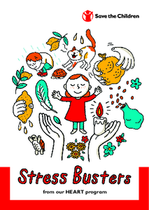
Save the Children is sharing these drama-based relaxation exercises that are part of their global Healing and Education through the Arts (HEART) program for children living in stressful situations.
This paper identifies key ethical considerations when undertaking evidence generation involving children during the mitigation stage of the pandemic (emergency phase), on subject matter relating to COVID-19 once the pandemic has been contained, and once containment policy measures, including lockdowns, have been lifted (post-emergency phase).
UNICEF Innocenti is mobilizing a rapid research response in line with UNICEF’s global response to the COVID-19 crisis. This microsite features resources and research projects covering a rapid review of evidence, education analysis, and social and economic policies.
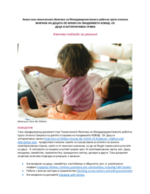
Този придружаващ документ към Техническата бележка на Междуведомствената работна група относно Закрила на детето по време на пандемията КОВИД -19: Деца и алтернативна грижа Protection of Children during the COVID-19 Pandemic: Children and Alternative Care предоставя полезни съвети за насърчаване участието на всички заинтересовани страни, което е от ключово значение, за да не бъдат прекъснати услугите за деца.
Целта на тази „Специализирана информация“ е да подпомогне работещите в сферата на закрила на детето и правителствените служители в незабавния им отговор на проблемите, пред които се изправят децата, които са в риск от разделяне със семейството или в алтернативна грижа по време на пандемията от Ковид-19.
This guidance note is focused on the ‘here and now’ – and a set of recommendations to guide the work of Savings Groups during the global pandemic.
This comic is based on a radio story that NPR education reporter Cory Turner did. He asked some experts what kids might want to know about the new coronavirus discovered in China.
This study aimed to determine the approach to child welfare in Iran by reviewing Iran’s laws and macro policies, and analysing them to provide an explicit and comprehensive definition for child welfare.