Displaying 401 - 410 of 859
The report highlights how children’s movement is driven by different motivations, exposes children to different forms of harm, and presents multiple barriers to accessing services.
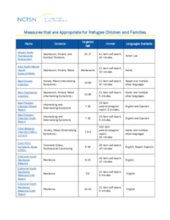
The National Child Traumatic Network (NCTN) has published a list of measures that front line professionals can use to assess the exposure to trauma among migrant and refugee families and children.
This dissertation examines the communication between left-behind children in China and their migrant parents from the three-level perspective of relational maintenance (Dainton, 2003): the self, the system, and the network contexts.
This chapter describes and proposes a new social inclusion model for supporting unaccompanied minors in becoming autonomous, as they are one of the most vulnerable groups of contemporary migration flows.
This study explores conceptions of the notion of unaccompanied minors (UM) in Senegal and analyzes the resources and coping mechanisms of these minors when confronted with migratory traumas.
In this report, Amnesty International UK, the Refugee Council and Save the Children expose how the UK Government’s policy on refugee family reunion is damaging the lives of children in the UK, and how its justifications for the policy are unsubstantiated.
This paper presents a juvenile delinquency prevention program for unaccompanied foreign minors in street situations in Ceuta, Spain. The main objective is to assess the implementation and results of this program.
While previous studies have focused on the effects of parental deportation on young children, this study uniquely contributes to the literature by exploring how adolescents experience and cope with a forced family separation.
While previous studies have focused on the effects of parental deportation on young children, this study uniquely contributes to the literature by exploring how adolescents experience and cope with a forced family separation.
This study investigated the effect of parental migration on the health of left behind-children and adolescents in low-income and middle-income countries (LMICs).