
Displaying 1 - 10 of 506
This article examines compassion as a relational institutional ethos within alternative residential child care in Nepal. Drawing on qualitative case study research conducted in a children’s home operating in collaboration with local and international non-governmental organisations, the study explores how Tibetan Buddhist ethical principles intersect with contemporary safeguarding and governance frameworks.
This study of children in residential care in Pakistan finds that perceived institutional neglect is strongly linked to attachment insecurity, emotional dysregulation, and conduct problems, with attachment insecurity acting as a key mediating factor. The study highlights the importance of enhanced caregiver training, emotional support mechanisms, and the establishment of nurturing and stable environments within residential institutions to promote children’s psychological well-being and social adjustment.
This study explores how minors in out-of-family care in Belgium experience placements and what improvements they recommend, based on interviews with youth in residential facilities. It finds that placements are often confusing and disruptive, and emphasizes the need for more child-centered, developmentally appropriate care that addresses both emotional needs and everyday living conditions.
The Vanam Vasapadum initiative evaluated an arts-based, trauma-informed social-emotional learning program for children in institutional care in Tamil Nadu, finding significant improvements in self-esteem and psychological well-being over three years. Both quantitative and qualitative results highlight that creative, holistic interventions can enhance emotional regulation, resilience, and social skills among vulnerable adolescents, suggesting strong potential for broader mental health promotion.
This scoping review highlights the limited evidence on young people aged 15–17 entering care for the first time, with only five studies meeting inclusion criteria. It finds that care entry for this group is linked to complex individual and family factors, underscoring the need for more diverse and in-depth research to better inform early interventions and prevention strategies.
This study of young people in residential care in Romania finds that childhood trauma and maladaptive coping are linked to poorer perceived social skills, while adaptive coping is associated with better outcomes. It also shows that self-efficacy plays a key moderating role, highlighting the importance of building both confidence and adaptive coping skills to support healthy social development regardless of trauma exposure.
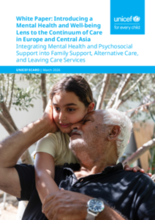
Children in Europe and Central Asia who are at risk of, in, or transitioning from alternative care face significantly higher rates of mental health challenges, which can contribute to family separation, placement instability, and poor reintegration outcomes. This paper highlights the urgent need to integrate mental health and psychosocial support (MHPSS) across the continuum of care and provides practical, evidence-based guidance for governments and practitioners to embed mental health promotion, prevention, and care into child protection systems.
This article examines the growing prevalence of child-headed households in Zimbabwe, exploring the challenges these children face and the effectiveness of community-based interventions in supporting their wellbeing. It highlights the role of families, community networks, and social services in mitigating risks and proposes a holistic, community-driven model to strengthen resilience and improve outcomes for vulnerable children.
This study finds that grandparenting as primary care in China is generally associated with lower overall and social-emotional development among preschool children. However, it can have a protective effect for children living with a single parent—particularly in low-income families—highlighting the need for targeted support and training for grandparent caregivers.
This working paper by Joan Lombardi, senior advisor to the Collaborative on Global Children's Issues, and Lauren Simmons provides a brief overview of the risks and potential of early childhood and the changing climate and showcases a dozen innovative approaches where early childhood and climate sectors have successfully converged.
