
Displaying 1041 - 1050 of 1807
This country care review includes the care-related Concluding Observations adopted by the Committee on the Rights of the Child as part of its examination of the combined second and third periodic reports of The Gambia (CRC/C/GAM/2-3).

This country care review includes the care-related Concluding Observations adopted by the Committee on the Rights of the Child as part of its examination of the fourth periodic reports of Switzerland (CRC/C/CHE /2-4).
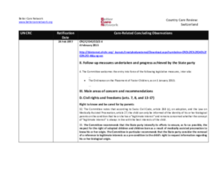
This country care review includes the care-related Concluding Observations adopted by the Committee on the Rights of the Child as part of its examination of the consolidated third and fourth periodic reports of Jamaica (CRC/C/JAM/3-4).
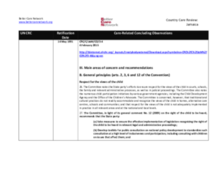
This country care review includes the care-related Concluding Observations adopted by the Committee on the Rights of the Child as part of its examination of the third to fifth combined periodic reports of Tanzania (CRC/C/TZA/3-5).
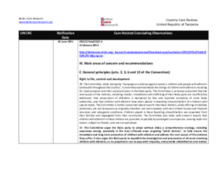
This country care review includes the care related Concluding Observations adopted by the Committee on the Rights of the Child.
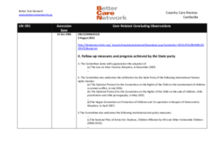
This editorial piece from the Child & Youth Services journal makes observations about the children who live away from home and their vulnerability to violence, the shift in the use of violence as a threat to democracy to its use as a defense of democracy, and the exclusion of young people from globalization.
This paper discusses and examines the lessons learned from the Munro Review relevant for looked after children. The Munro Review provides an analysis of the current state of the child protection system, challenging bureaucratised practice and arguing for a reclaiming of professional social work identity, knowledge and understanding.
This paper provides a brief overview of basic family structures in EU countries and a description of family breakdown and its impact on children’s wellbeing.
This article from the Migration Policy Institute examines the impact of labor migration on children who are left behind, from an economic and social lens, and with particular attention to gendered implications.
This report discusses concerns raised by participants of Thematic Area 3 (Intercountry Adoption Agencies and the HCIA) of the International Forum on Intercountry Adoption and Global Surrogacy held in August 2014.