Displaying 1251 - 1260 of 1807
This paper was commissioned by Family for Every Child and is part of an inter-agency series on the links between child protection and major development goals. This report focuses on the links between child protection and economic growth.
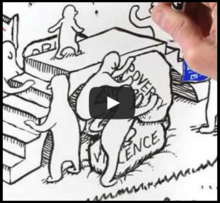
This 5-minute animated video depicts a theory of change for achieving breakthrough outcomes for vulnerable children and families. It describes the need to focus on building the capabilities of caregivers and strengthening the communities that together form the environment of relationships essential to children’s lifelong learning, health, and behavior.
This report produced by the Center for Educational Research and Save the Children summarises a broader research study which examined the foster care pilot programme introduced in Armenia in 2005. The study aimed to find out if the pilot program succeeded, what problems arose, how the program could be improved and how foster care in Armenia could develop and expand effectively.
Representatives from International Social Service, Save the Children, and SOS Children’s Villages met with the African Committee on Experts on the Rights and Welfare of the Child during its 21st session on 15 April, 2013 to present on the international Guidelines for the Alternative Care of Children (UNGA resolution A/RES/64/142) and its new implementation Handbook “Moving Forward.”
Charts that accompany the article Orphan Fever: The Evangelical Movement’s Adoption Obsession, illustrating the trends in international adoptions from Liberia, Kyrgyzstan, Ethiopia, Uganda, and Haiti to families in the United States.
Statement by Ms. Jennifer Davidson, CELCIS & co-author of the Handbook on the occasion of the launch of the handbook ‘Moving Forward: Implementing the ‘Guidelines for the Alternative Care of Children’ at UNICEF House in New York on the 11th April 2013.
Statement by Ms. Regina Maria Cordeiro Deputy Permanent Representative of Brazil to the United Nations on the occasion of the launch of the handbook ‘Moving Forward: Implementing the ‘Guidelines for the Alternative Care of Children’ at UNICEF House in New York on the 11th April 2013
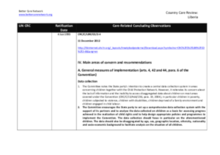
This country care review includes the Concluding Observations for the Committee on the Rights of the Child adopted as part of its examination of Liberia's second and fourth periodic reports at the 61st Session of the Committee held between 17 September and 5 October, 2012. The Committee’s recommendations on the issue of Family Environment and Alternative Care as well as other care relevant issues are highlighted.
This country care review includes the Concluding Observations for the Committee on the Rights of the Child adopted as part of its examination of Andorra's second periodic report at the 61st Session of the Committee held between 17 September and 5 October, 2012, as well as other care-related concluding observations, ratification dates, and links to the Universal Periodic Review and Hague Intercountry Adoption Country Profile.
This Program Review documents the evolution of EveryChild/Partnerships for Every Child’s Program in Moldova since 1994, presenting the development of interventions to improve the lives of children through deinstitutionalization and identifying the best practices and lessons that may be relevant, useful, and replicable to other initiatives and organizations around the world.