
Displaying 631 - 640 of 1810
This country care review includes the care-related Concluding Observations adopted by the Committee on the Rights of the Child and the Committee on the Rights of Persons with Disabilities.
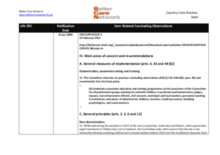
This country care review includes the care-related Concluding Observations adopted by the Committee on the Rights of Persons with Disabilities.
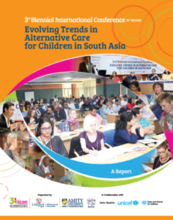
This is the report of the 3rd Biennial International Conference (3rd BICON) on “Evolving Trends in Alternative Care for Children in South Asia” that was convened by Udayan Care on March 16 & 17, 2018 at Amity University, Noida NCR (India).
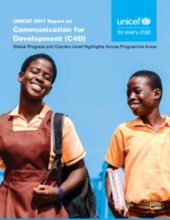
The following report summarizes how UNICEF and its partners have utilized Communication for Development strategies in their work during the period of UNICEF’s Strategic Plan 2014-2017, with an emphasis on 2017.
This research examines how federal immigration policy impacted child migrants at the local Hudson Valley level and the collective response by service providers, educators, activists, and immigration lawyers to effectively deal with the crisis.
Based on an analysis of the evolutions in the way the care structures for unaccompanied minors were set up in Belgium, the authors of this article critically reflect on the underlying rationales that justify the particularities of these structures, hereby also reflecting about the implications of these rationales for professionals and researchers.
The purpose of this article is to describe the impact of current and evolving immigration policy on the health of unaccompanied children, to delineate barriers to care and challenges they face prior to gaining legal relief, and to suggest policy recommendations that support health and safety for them from the point of apprehension to and through achieving legal status.
This article contributes to a growing body of research that takes the user perspective as its point of departure when conducting research in social work to examine how parents perceive and experience child protection practice.
This paper is about child protection issues in Pakistan, one of the South Asian countries in the Indian sub-continent.
In this study, using paired observations of group supervision and family meetings alongside interviews with parents, the authors explored the link between supervision, practice, and engagement.