Displaying 61 - 70 of 463
This paper investigates whether the Government of Zimbabwe’s Harmonized Social Cash Transfer (HSCT) Program, which combines cash transfers with complementary services, affects youth exposure to physical violence.
This Scoping Study and Sector Review, produced under the guidance of the Ministry of Employment, Social Affairs and Family (MESAF) of Somaliland and Save the Children, is a strategic analysis of the existing policy landscape in Somaliland in order to inform the development of a Social Protection system.
This report from ODI and UNICEF critically reviews the case for universal child benefits (UCBs). It seeks to contribute to a burgeoning and lively debate on the (potential) role of UCBs as a policy instrument in the pursuit of child poverty reduction and universal social protection.
This paper examines the frequency with which transition-age foster youth receive asset building services and whether the youth who receive services experience improved outcomes compared to those who do not.
This WHO–UNICEF–Lancet Commission lays the foundations for a new global movement for child health that addresses the two crises of climate change and predatory commercial exploitation, and presents high-level recommendations that position children at the centre of the Sustainable Development Goals (SDGs).
This study used wave 2 of the U.S. National Survey of Child and Adolescent Well-Being II (NSCAW II) to develop a new typology of kinship care based on financial mechanisms, including: (1) families that received Temporary Assistance for Needy Families (TANF) only; (2) families that received foster care payments only; (3) families that received both TANF benefits and foster care payments; and (4) families that received no payments.
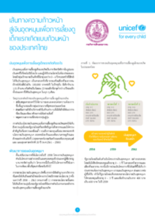
This brief from UNICEF describes the Child Support Grant (CSG), a non-contributory, non-conditional targeted cash transfer to caregivers of children between ages 0-6 in Thailand.
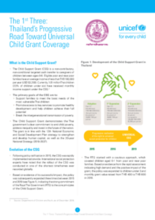
This brief from UNICEF describes the Child Support Grant (CSG), a non-contributory, non-conditional targeted cash transfer to caregivers of children between ages 0-6 in Thailand.
This study used variations in the adoption and refund status of state-level Earned Income Tax Credit (EITC), a socioeconomic policy intended to reduce poverty, to examine their effect on foster care entry rates in the U.S.
This report presents the results of an evaluation of the Partnering for Family Success (PFS) program, which was conceived as an innovative intervention to address the particular needs of housing unstable families who had a child in the custody of the county child welfare agency.