Displaying 1471 - 1480 of 1531
Upwards of, and possibly more than 500 000 Australians experienced care in an orphanage, Home or other form of out-of-home care during the last century. This report shares their stories.
This report contains an overview of alternative care in Europe, the effects of institutions on children, statistical information and the different approaches of child protection systems within Europe. It includes reforming institutional care, foster care, post-care support, and the role of the social worker.
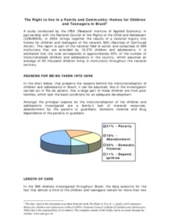
This research study provides statistical information on institutional care of children under the age of 12 in Brazil. Interviews with institutions and children are conducted, and reasons for separation from family, length of time in care, status of family relationship, religious orientation and financial support of the institutions are highlighted.
Standards and criteria for the development of residential services for children in the Monteserrat, Turks and Caicos, and the British Virgin Islands.
Analyzes the state of institutional care in Zimbabwe against the national child protection policy. Focuses on the role of donors in the proliferation of institutional care and strategies to better regulate the development and provision of child protection services.
Residential care for children has aroused much controversy. Several scandals involving the physical and sexual abuse of residents have led to public inquiries and reports (Kent, 1997; Utting, 1997; Waterhouse, 2000).
This document represents the agreements made at the Second International Conference on Children and Residential Care in Stockholm, Sweden, held from 12 to 15 May, 2003. The conference was sponsored by the Swedish Foreign Ministry and the Swedish International Development and Co-operation Agency (Sida). The document includes the principles and actions, regarding children and residential care, that were agreed upon by the participants at the conference.
The objective of this research project is to contribute to the process of facilitating a more family-like childhood for Russian orphans.
These Standards are based on the relevant legislation, regulation and guidance and best practice derived from evidence based research and professional experience from Ireland and abroad.
An overview of the largest longitudinal investigation of institutionalized children less than 2 years old ever conducted.