
File
Displaying 1 - 10 of 21
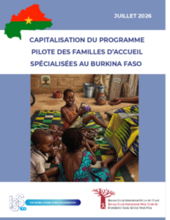
ISS and ISS West Africa, in collaboration with the child protection authorities of Burkina Faso, have been implementing since 2018 a pilot programme of specialised foster families for children living with disabilities. After six years of implementation, ISS has undertaken a capitalisation process to analyse and document this pilot experience and identify the main lessons learned, with a view to strengthening and potentially scaling up the project at a national level.
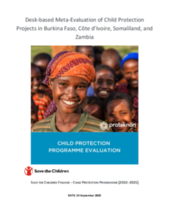
The report is a meta-evaluation of Save the Children Finland’s Global Child Protection programme, implemented from 2022 to 2025 in four countries in Africa – Burkina Faso, Côte d´Ivoire, Somaliland and Zambia – spanning development, humanitarian and peace-building contexts.
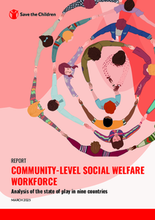
This report, based on a study across nine countries, examines how to strengthen the community-level social welfare workforce (CLSWW) as a vital but under-resourced part of national child protection systems. It calls for context-specific strategies that clearly define roles and competencies, build capacity, and align with local norms, mechanisms, and resources to enhance child protection outcomes.
By drawing on the experiences of parents, advocates, NGOs, and public officials, this side event invited discussion on how, through strengthening families and tools for prevention, societies can reduce the number of children being institutionalized. During the event, a panel of experts from the Republic of Moldova, South Africa, Burkina Faso, Vietnam, and the United States explored their experiences around efforts to empower parents and keep children with disabilities with their families.
By drawing on the experiences of parents, advocates, NGOs, and public officials, this side event will invite discussion on how through strengthening families and tools for prevention, societies can reduce the number of children being institutionalized.
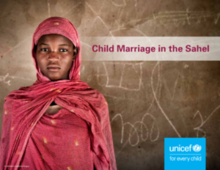
This brochure from UNICEF provides an overview of child marriage in the Sahel, a region spanning the northern portion of sub-Saharan Africa.
This paper examines all policy and laws related to families in the South, West, East and Central regions of sub-Saharan Africa.
The special issue of Emerging Adulthood titled “Care-Leaving in Africa” is the first collection of essays on care-leaving by African scholars. This article, coauthored by scholars from North and South, argues in favor of North–South dialogue but highlights several challenges inherent in this, including the indigenizing and thus marginalizing of African experience and scholarship and divergent constructions of key social concepts.
This article presents the results of a systematic mapping of social work training programs in countries throughout West Africa, a region historically under‐represented in global discussions of the social welfare workforce.
This study tests the effects of economic intervention—alone and in combination with a family-focused component—on parenting outcomes and children’s reports of violence in rural Burkina Faso.