
The impacts of institutional child sexual abuse: A rapid review of the evidence
This report reviews the existing literature on the impact of child sexual abuse within various types of institutional care settings around the world.
This report reviews the existing literature on the impact of child sexual abuse within various types of institutional care settings around the world.
The present report was submitted to the UN Security Council Working Group on Children and Armed Conflict and focuses on the trends and patterns of the six categories of grave violations committed against children.
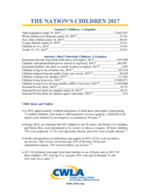
The Nation's Children 2017 provides the most up-to-date data on the status of children in the United States, with statistics on children in out-of-home care, child abuse and neglect, adoption, poverty and other risk factors, and more.
The 24 chapters of this book contain research examining the institutionalization of children, child abuse and neglect in residential care, and interventions preventing and responding to violence against children living in out-of-home care settings around the world.
This chapter serves as an introduction to the book Child Maltreatment in Residential Care and provides a brief overview of the research on child maltreatment within the context of institutional care.
This report evaluates UNICEF's child protection systems building approach in Myanmar, including the review methodology, findings, conclusions and lessons learned, as well as recommendations for the future.
Drawing upon census data, this report shows that place, race, and poverty are intertwined concepts with particular implications for young children.
In this case study, Coordinating Comprehensive Care of Children (4Children) documents and evaluates the work of COGRI’s Lea Toto program and the FHI360 led APHIAplus program in Kenya.
In this case study, Coordinating Comprehensive Care of Children (4Children) documents and evaluates the work of Pact's Yekokeb Berhan Program for Highly Vulnerable Children in Ethiopia.
In this case study, Coordinating Comprehensive Care of Children (4Children) documents and evaluates the work of the World Education/Bantwana Expanded IMPACT program in Zimbabwe.
This paper is the final chapter of Child Maltreatment in Residential Care, summarizing and analyzing the research presented on child maltreatment in institutions, its impact on children, and prevention and intervention strategies.
This paper provides evidence-based guidance on the use of family interventions involving children with a history of institutionalization prior to their placement in family-based care through foster care, adoption, or reunification with their families.
This paper utilizes a harm-reduction framework to present best practices for improving residential care and reducing the negative effects residential care can have on children's development.
This chapter in Child Maltreatment in Residential Care provides a brief history of congregate care in the United States and the experiences of maltreatment of children and youth within congregate care settings as they shifted over time.
This study explored the experiences of maltreatment and outcomes of adult care-leavers in Australia who lived in out-of-home care as children.
This chapter from Child Maltreatment in Residential Care provides an overview of institutional care in Latin America and the Carribean, describes current efforts toward deinsitutionalization and child care reform in the region, and discusses practical suggestions for further research and reform.
This chapter of Child Maltreatment in Residential Care discusses the findings from a multi-country study comparing the incidence of maltreatment in institution-based and family-based care and offers recommendations based on the findings.
This chapter of Child Maltreatment in Residential Care describes Interaction Competencies with Children – for Caregivers (ICC-C), a preventative intervention approach to improve the quality of care and reduce the incidence of maltreatment within institutional care settings in Sub-Saharan Africa.
This study investigated the incidence of maltreatment experienced by children living outside parental care, comparing the prevalence of abuse between children living with extended family, children living in institutional care, and children living or working on the street.
This chapter of Child Maltreatment in Residential Care describes the progression of changes in China's child care and protection policies to reduce the use of institutional care for children and increase efforts toward family strengthening and family-based models of alternative care.
This study analyzed the experiences of victimization by peers and staff of adolescents living in Israeli residential care settings.
This chapter of Child Maltreatment in Residential Care provides a background on the development of the child welfare system in Turkey, focused on the transition from institutional care toward family-based care and higher standards for institutions.
This study provides a background on the historical, cultural, and social circumstances in Ukraine as it relates to the continued institutionalization of children in the country, despite efforts for reform.
This chapter of Child Maltreatment in Residential Care describes the history of child care institutions in the Russian Federation and the legislative changes implemented to improve the situation of children living in residential care settings.
This report summarizes the findings from various studies investigating child sexual abuse within institutional care throughout Austria, Germany, and Switzerland and offers suggestions for future research and intervention.