Displaying 41 - 50 of 1059
This report documents the finding of the exercise undertaken by the Children and Families Together (CAFT)-India consortium to assess how Indian states are positioned for disability-inclusive care reform. Drawing from data across States, this highlights each State’s existing care systems and inclusion practices, offering valuable insights for policymakers, practitioners, and organizations advancing inclusive child protection and care reform in India.
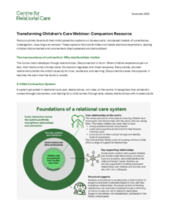
This webinar, co-hosted by the Columbia University Seminar on Global Mental Health, examined how the shift toward localization is reshaping community-based child protection. The session explored both the challenges and opportunities of localizing child protection and well-being initiatives, emphasizing the need to transfer power to communities and support genuine local ownership for sustainable impact.
On November 12, the Transforming Children's Care Collaborative hosted a webinar to explore insights from two Australian initiatives
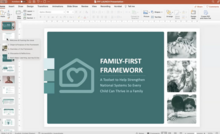
On Monday, November 3rd, A Family for Every Orphan hosted an interactive consultation and introductory launch of the Family-First Framework — a practical and
On 3 November 2025 the UK FCDO and Hope and Homes for Children convened a Virtual Solutions Session
Changing the Way We Care’s “Care System Strengthening Learning Synthesis: Evaluation Summary” distills lessons from care reform efforts in four countries, examining how change happened across laws, workforce, financing, monitoring, and services. It finds that evidence-based advocacy, strong government ownership, collaboration, and capacity-building were central to driving and sustaining reform across diverse contexts.

Building on a presentation invited for a Kilbrandon Children’s Research webinar on media representations of children and young people in the care and criminal justice system, this article discusses the legacies of Canadian ‘care’ practices premised on violent assimilation and erasure.
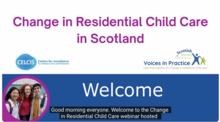
CELCIS’ October 2025 webinar explored recent developments in residential child care across Scotland, featuring insights on nurture-based practice, shifts in inspection approaches aligned with The Promise, and staff development through reflective practice. Speakers highlighted how new care models, regulatory changes, and whole-system approaches are strengthening practice and improving outcomes for children and young people.
Countries that sign the Global Charter on Children's Care Reform are encouraged to make their own commitments describing specific actions they will take to realise the aims of the Charter. This guidance document aims to support governments to design ambitious, measurable, and context-specific commitments that align with the Charter’s principles.