Displaying 111 - 120 of 571
As technology enhancements effectively augment family-based interventions, the purpose of this study was to pilot a smartphone application (app) in the context of a trauma and behavior management-informed training for foster and kinship caregivers.
The Opening Doors for Europe’s Children – a pan-European campaign that advocates for strengthening families and ending institutional care – released 16 country fact sheets about the progress with the transition from institutional to family- and community-based care (also known as deinstitutionalisation) in 2018.
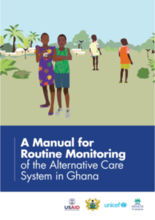
The purpose of this manual is to provide guidance on how to collect and report data on children in formal alternative care in Ghana in a standardised way, and to analyse, present, and make the data available for use.
This resource compiles critical data from a variety of sources on children, youth, and families who came in contact with the US child welfare system in federal fiscal year (FY) 2017.
This study examined the predictive power of the Strength and Difficulties Questionnaire (SDQ) for predicting foster placement breakdown.
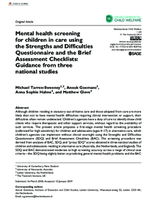
The present article proposes a first-stage mental health screening procedure (calibrated for high sensitivity) for children and adolescents (ages 4–17) in alternative care, which children’s agencies can implement without clinical oversight using the Strengths and Difficulties Questionnaire (SDQ) and Brief Assessment Checklists (BAC).
Information and Communications Technologies (ICT) are increasingly, and increasingly effectively, being used in development and humanitarian work. Whereas health and education lead this use, application to child protection remains sparse and ill-understood. This paper helps address these two gaps.
This report presents data on children at risk and separated from their parents in Moldova.
This report - prepared for the European Commission by Applica and the Luxembourg Institute of Socio-Economic Research (LISER), in close collaboration with Eurochild and Save the Children - provides a first mapping of the situation across the 28 Member States of the EU outlining the situation in relation to children, particularly the four target groups (TGs) of disadvantaged children (children in institutions, children with disabilities, children of recent migrants and refugees, and children living in precarious family situations) as well as an indication of the key issues in relation to children’s access to the five policy areas (PAs): housing, healthcare, nutrition, early childhood education and care, and education.
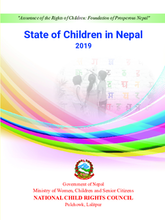
The national report on the State of Children in Nepal, 2019 includes child related information - Constitutional and legal provisions, policy, programmatic efforts and results in line with the implementation of the Convention on the Rights of the Child.