File
Displaying 71 - 80 of 163
This document examines 13 projects serving HIV services to adolescents in PEPFAR-supported countries and provides a set of guidelines on best practices for adolescent and youth-friendly HIV programs.
This brief paper highlights some of Young Lives key findings on violence affecting children, exploring what children say about violence, how it affects them, and the key themes that emerges from a systematic analysis of the children’s accounts.

This document is an evaluation of Retrak’s reintegration of street children and community-based child protection project in SNNPR, Ethiopia.
ACPF is holding its Seventh International Policy Conference on the African Child (IPC) under the theme:“Our Hidden Shame: Crimes and Extreme Violence against Children in Africa” on 7-8 November 2016 at the United Nations Conference Centre in Addis Ababa, Ethiopia.
This country care review includes the care-related Concluding Observations adopted by the Committee on the Rights of Persons with Disabilities during the sixteenth session (15 Aug 2016 – 2 Sep 2016) of the Convention on the Rights of Persons with Disabilities.

This issue brief from the UNHCR highlights key messages from UNHCR in regards to family tracing and reunification. The brief outlines the importance of children growing up in a safe family environment and the positive impact this has on a child's psychological, cognitive and physical development. In the best case, alternative care is only required as an interim measure while family tracing is carried out and until the time when children can be reunited with parents or family members.This brief is part of a series developed by UNHCR which aims to guide field operations on key thematic child protection issues.

In this Ethiopia Child Protection Fact Sheet, UNHCR provides the main child protection highlights, issues, and trends for 2014 to 2016.
This is a joint statement issued by ACPF and the Global Partnership to End Violence against Children following the Multi-Stakeholder Consultation on Ending Violence against children in Africa held in Addis Ababa, on September 29th and 30th, 2016.
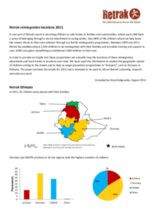
Each year Retrak maps the locations of family reintegration placements and tracks trends in locations over time. They have used this information to help them understand the geographic spread of children coming to the streets and to target prevention programmes on ‘’hotspots’’- places from which many children migrate to the streets.
This book published jointly by FAO, UNICEF, and Oxford University Press presents the findings from evaluations of the Transfer Project, a cash transfer project undertaken in the following sub-Saharan African countries: Ethiopia, Ghana, Kenya, Lesotho, Malawi, South Africa, Zambia, and Zimbabwe. It concludes that cash transfers are becoming a key means for social protection in developing countries.