File
Displaying 91 - 100 of 162
In this video from the BBC, Clive Myrie reports from Ethiopia, the first stop for many Eritrean migrants en route to Europe. The video features a few of these child migrants who are waiting in Ethiopia to make their way to Europe in hopes of a better life.
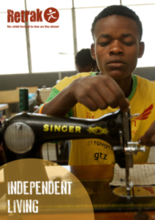
This literature review explores current international and selected national policy on independent living arrangements and examines the evidence of good practice from existing independent living programmes for care leavers in order to assess how both of the above can be applied to street-connected children.
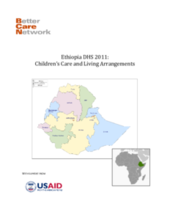
This country brief provides an overview of data on children’s living arrangements in Ethiopia, extracted from the 2011 DHS survey.
This interpretive study examines the experiences of 54 Ethiopian emerging adults who had aged out of institutional care facilities.
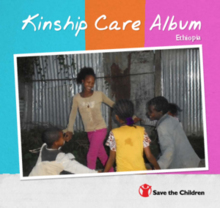
This album presents viewpoints of children and young people, who have been engaged in this participatory research on kinship care - as advisors, researchers, respondents and documenters during the months of June to December, 2014.
This video briefly recaps the Africa-Wide Children without Appropriate Care Program Learning Event hosted by Save the Children in Addis Ababa, Ethiopia, on 20-23 April 2015.
This presentation provides an overview of the status of care reform efforts in Africa. It identifies where care reform is underway as well as areas in which reform is still needed. The presentation looks ahead to what is needed to accelerate the momentum on care reform in the region.
This presentation was delivered at the Africa-Wide Children Without Appropriate Care Program Learning Event: “Shaping our care reform work across Africa,” held in Ethiopia on 20-23 April 2015. It provides an overview of the Tracking Progress Initiative, which includes the development of a tool to measure country progress in implementing the Guidelines for the Alternative Care of Children.
Various stakeholders, including Better Care Network, met at an Africa wide Program Learning Event on 20-23 April 2015, organized by Save the Children, under the theme “Shaping our care reform work across Africa,” which brought together country, regional and global experts.
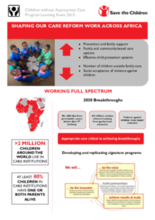
This document provides an overview of the topics covered in the various sessions during the three-day program learning event “Shaping our care reform work across Africa,” held in Ethiopia on 20-23 April 2015.