Displaying 51 - 60 of 794
This study aimed to analyze the narratives of social educators regarding their practices within a foster care institution for children and adolescents in South Brazil.

This article provides a unique comparison of four non-professional stakeholder groups involved with dependency courts overseeing child protective services cases in the state of Maryland in the United States.
The purpose of this longitudinal study conducted on institutionalized infants and toddlers in Switzerland from 1958 to 1961 and then 60 years later on the same group, is to investigate the effects of psychosocial deprivation on cognitive functioning in late adulthood.
This article reviews a study conducted about child development in residential care, foster/kafalah care, and adoptive families. The authors of the study demonstrated that institutions cannot provide safe, stable, and shared care for children, and lead to substantial delays in their development, not only for physical health but also for mental health and neurocognitive growth.
This study aimed to investigate developmental outcomes of children raised in institutions in Switzerland in conditions of psychosocial deprivation and to identify possible risk and protective factors at institutional and child levels.

In this chapter, the authors explore the intricate relationships between young disabled children, their families, institutional settings, and disability services in Canada, with an emphasis on the challenges stemming from unstable custodial dynamics and governmental interference.

Through this study, the researcher has attempted to view the Child Protection System from the lived experiences of 10 children who are/have been part of the Child Protection System in Delhi, India.

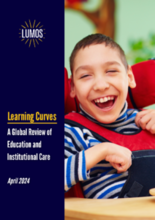
This Global Thematic Review on Education examines the under-researched relationship between education and institutional care.
Dr. Charles Nelson III, a Professor of Pediatrics and Neuroscience and Professor of Education at Harvard University, explains the role of experience in brain development, the effects of early profound deprivation on development, the history of institutional care, and an overview of institutional care at an international conference on 21 March 2024.

The Moldova Ministry of Labor and Social Protection, in cooperation with CTWWC Moldova and local partner CCF Moldova, organized an international conference on March 21, 2024. More than 100 participants, representing the wide array of care reform actors and decision makers in the central and local government, NGOs, academia and international experts, reviewed findings of the Bucharest Early Intervention Project and national research conducted in 2023 on the potential for a moratorium on placing children 0-6 in institutional care.