
The Cost of Case Management in Orphans and Vulnerable Children Programs: Findings from Nigeria
This brief outlines the findings from the Systems Transformed for Empowered Actions and Enabling Responses (STEER) project, in Nigeria.
File
This brief outlines the findings from the Systems Transformed for Empowered Actions and Enabling Responses (STEER) project, in Nigeria.
The alternative care for children newsletter provides updates following assessment workshops on care reform that were conducted in Armenia, Ghana, Moldova, and Uganda.
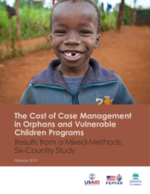
USAID and PEPFAR-funded MEASURE Evaluation worked with six OVC projects in six countries to gain insight on current approaches to OVC case management, map how costs can be linked to OVC case management activities, and determine the cost of OVC case management.
This brief outlines the findings from the Better Outcomes for Children and Youth project, in Uganda
In 2017, the USAID Displaced Children and Orphans Fund (DCOF) of the United States Agency for International Development (USAID) engaged the USAID-funded MEASURE Evaluation to build on and reinforce progress in advancing national efforts on behalf of children who lack adequate family-based care in Uganda.
The Armenian Ministry of Labor and Social Affairs (MOLSA), with funding and technical assistance from the Displaced Children and Orphans Fund (DCOF) of the United States Agency for International Development (USAID) and MEASURE Evaluation, conducted a self-assessment of the care reform system at a participatory stakeholder workshop held in Armenia.
This brief explains the structure and roles of this country core team (CCT) established by Armenia’s Ministry of Labor and Social Affairs in June 2017 and the team’s usefulness as a platform for collaboration for the reform of national policies and systems for the care of vulnerable children: “national care reform.”
This literature review addresses how international adoption affects Uganda’s orphan care methods from both micro and macro perspectives.
The purpose of the assessment was two-fold: To identify legislative provisions that are incompatible with international standards, as well as the gaps where the legislation fails to recognise or does not adequately recognise or protect international human rights standards.
The aim of this audit was to assess how the Ministry of Gender, Labour and Social Development (MOGLSD) is handling the current adoption process of children leaving in a bid to protect their rights and welfare.
