
Displaying 451 - 460 of 511
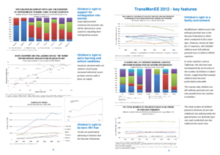
TransMonEE is a database that captures a vast range of data on social and economic issues relevant to the situation and wellbeing of children, adolescents and women in 28 countries of Central and Eastern Europe, Commonwealth of Independent States and the European Union. This document includes inter-country comparisons of data on several issues related to children’s care.
This edition of Insights produced by UNICEF summarizes the findings and recommendations of studies on the impact and outreach of social protection systems in Albania, Kazakhstan, and Ukraine where high rates of child placement in formal care still persist. The research offers important insight into the weaknesses and challenges faced by social protection systems in the region, but also point to ways in which policy-makers might maximise the impact of social protection systems in order to ‘keep families together’.
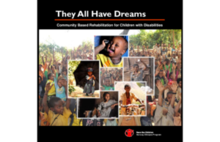
The intention of this booklet is to document and share the good practices and results that the Save the Children Norway – Ethiopia (SCN-E) project has achieved at different levels with improved outcomes on the lives of the individual child with disability, families, the community, and institutions.
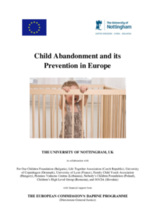
This comprehensive manual provides an overview of child abandonment and its prevention in Europe, exploring the extent of child abandonment, possible reasons behind this phenomenon, the consequences of abandonment, and good practices in terms of prevention. For the purposes of the EU Daphne-funded project, child abandonment is defined in two ways, namely open and secret abandonment. Country specific in-depth reviews of child abandonment and its prevention are provided for 10 countries and results from an EU-wide survey analyzed.
This Prakas is intended to define roles and responsibilities of relevant competent agencies and establish procedures, operational guides, and forms to implement the Policy on Alternative Care for Children.
This independent assessment examined, specifically, the deinstitutionalisation of children in special education boarding schools and child care institutions in the Republic of Georgia.
This report is the product of a year-long investigation and collaboration between Disability Rights International (DRI) and the Comisión Mexicana de Defensa y Promoción de los Derechos Humanos (CMDPDH). From August 2009 through September 2010, DRI and the CMDPDH investigated psychiatric institutions, orphanages, shelters, and other public facilities that house children and adults with disabilities.
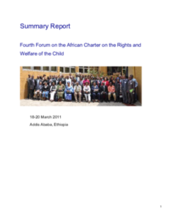
The following recommendations were made to the African Committee of Experts on the Rights and Welfare of the Child in relation to children without appropriate care.
This study on violence against children in state-run residential institutions in Kazakhstan was conducted under the national Office of the Commissioner for Human Rights and UNICEF. Data was collected from six different types of state run- residential institutions for children in 3 regions using a multi-methods approach, including surveys with children ( 9-18 years old) and staffs, and interviews with young people (17-23 years old) who had left the care of these institutions.
The first ever World report on disability, produced jointly by WHO and the World Bank, suggests that more than a billion people in the world today experience disability. This report provides the best available evidence about what works to overcome barriers to health care, rehabilitation, education, employment, and support services, and to create the environments which will enable people with disabilities to flourish. The report ends with a concrete set of recommended actions for governments and their partners.