
This section includes resources on the response to the COVID-19 pandemic as it relates to child protection and children's care.
News on COVID-19 and Children's Care
Webinars and Events on COVID-19 Response
Displaying 751 - 759 of 759
The Psychological First Aid Training Manual for Child Practitioners (PFA) was developed by Save the Children Denmark for the Child Protection Initiative, to facilitate training in psychological first aid with a focus on children.
The Minimum Standards for Child Protection in Humanitarian Action were formulated in 2011-2012 by the Child Protection Working Group (CPWG), an inter-agency working group composed of child protection practitioners, academics, and policy makers working to support child protection work in humanitarian settings.
Este informe presenta detalles de talleres para favorecer el desarrollo y adquisición de conocimientos, habilidades y destrezas para lograr una adecuada intervención psicosocial en las poblaciones afectadas por el terremoto/maremoto.

These guidelines reflect the insights of practitioners from different geographic regions, disciplines and sectors, and reflect an emerging consensus on good practice among practitioners. The core idea behind them is that, in the early phase of an emergency, social supports are essential to protect and support mental health and psychosocial well-being. In addition, the guidelines recommend selected psychological and psychiatric interventions for specific problems.
Guidelines for a multi-sectoral response to the most urgent mental health and psychosocial issues in emergency situations.
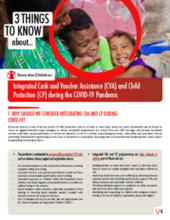
This resource from Save the Children answers the questions: (1) Why should we consider integrating Cash and Voucher Assistance (CVA) and Child Protection (CP) during COVID-19?; (2) What type of CVA & CP programming can be done during COVID-19?; and (3) How can we integrate CVA & CP?
In this first episode of a new special series on child development and COVID-19, Center Director Dr. Jack Shonkoff and host Sally Pfitzer discuss how to support healthy child development during a pandemic, including the importance of caring for caregivers.
This webinar featured presentations and discussions from practitioners who have experience of working on alternative care (short term and long term) and prioritising family-based care in emergency settings that could be helpful for practitioners in India as they plan a response for children who have lost parents to COVID-19.

This webpage from UNICEF features a list of resources for practitioners working with children during the COVID-19 pandemic.