Displaying 2161 - 2170 of 2235
This report presents the survey Kevin Browne and colleagues conducted in 33 European countries to identify the number and characteristics of children less than three placed in residential care without their parents for more than three months during the year ending December 31, 2003. The purpose was to assess the rate and cost of residential care as a response to children in adversity.
Serves as an example of fostering service standards from the perspective of children, birth families, and foster caregivers

Economist article which argues for changes in US federal welfare funding to maintain family unity and reduce the numbers of children entering into foster care.
A description of the programmatic steps taken in establishing a community-based foster home in Ethiopia and an evaluative follow-up on these children ten years later
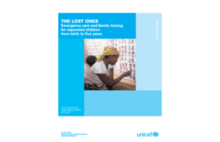
A manual primarily concerned with the prevention of separation of children during emergencies. It provides a field-oriented guide to solve problems specific to emergency care and tracing and family reunification of babies and children five years and younger.
Collection of articles highlighting suggestions on how to improve existing mechanisms for providing adequate care. Major article on the current state of international thinking on children without parental care.

A research study conducted with refugee children from Côte d’Ivoire and Liberia, and their foster caregivers in rural Guinea. Explores the experiences of both children and foster caregivers, and examines the role of ethnicity, gender and education. Highlights the significant capacity of a community to provide protection and care of refugee children, and offers recommendation for future research and programming.
This paper examines childcare policy in Mozambique. It finds that vulnerability increases when orphans are placed in resource-poor kinship care arrangements.
Analyzes household decisions to send and receive children via fostering. Results show fostering used as a social protection mechanism to cope with income shock (sending) and address family labor shortages (receiving).
This study examined attachment in institutionalized and community children 12 – 31 months of age in Bucharest, Romania.