Displaying 1051 - 1060 of 1531
In this chapter from Residential Child and Youth Care in a Developing World: Global Perspectives, First Edition Faizah Haji Mas’ud discusses the state of residential care in Malaysia. Mas’ud covers Malaysia and welfare policy, types of children’s services, as well as challenges and issues Malaysia faces in providing residential care to children.
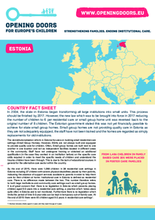
This Estonia Country Fact Sheet highlights the transformations made in deinstitutionalization in Estonia since 2004. By the end of 2015, there were 1,068 children in 38 residential care settings in Estonia.
In this chapter of Residential child and youth care in a developing world: Global perspectives, First Edition, the reader is introduced to residential care in Ghana.
This study revealed, through their narrations, the changes in the lived experiences of children who resided in residential childcare services regarding the going home process in a Chinese context.

Décadas de pesquisas comprovam que o crescimento em instituições de acolhida gera consequências psicológicas, emocionais e físicas, incluindo transtornos de apego, atrasos cognitivos e no desenvolvimento, e uma falta de habilidades sociais e de competências para a vida, trazendo diversas desvantagens na idade adulta.
This is a study from Catholic Relief Services that investigates the factors related to children’s placement in Catholic-affiliated residential care facilities in Zambia. According to this study, the government estimates that there are approximately 190 residential-care facilities located in Zambia, and of those 40 are Catholic-affiliated. At the time of this study, there were 1674 residents living in residential care.
Este manual proporciona orientación a los profesionales que trabajan con niños con discapacidades en el cuidado residencial.
This report highlights key findings from a social norms study conducted in Zimbabwe to understand the drivers of violence affecting children.
This paper aims to understand the functioning of institution in protecting the rights of children who are in need of care and protection and highlight measures for revamping the institutional care and revolutionizing family care.
The article aims to show the process of deinstitutionalisation in Bulgaria.