Displaying 581 - 590 of 1531
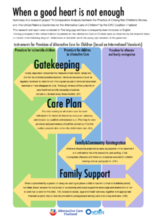
This field guide, produced by Apolitical in partnership with Hope and Homes for Children, is designed to help public servants understand the issue of children in care. It covers the following learning objectives: (1) Understand why experts say institutional care is harmful to children, (2) Learn about deinstitutionalisation and new approaches to replace institutions and prevent family separation, and (3) Learn about interventions that have improved outcomes for kids who do experience care.
In this article, the authors examine the experiences of transitions to work and the associated challenges for the agency of young people leaving residential care institutions in Luxembourg.
This summary report presents the findings of a study comparing practices within residential children's homes in the Thai province of Chiang Mai with the Guidelines for the Alternative Care of Children.
In this study, the authors analyzed the literature on foster care in Poland and conducted a narrative questionnaire with an educator who simultaneously holds the responsibility for teaching youth in foster care autonomy in order to identify factors that affect educational and vocational plans that foster care charges have.
The present study analyzes the process of deinstitutionalization in Romania, as a transition stage in the life of youngsters who leave care system after turning eighteen.

The paper describes the findings of a geographical mapping and analysis of residential care facilities in four regions of Ghana.
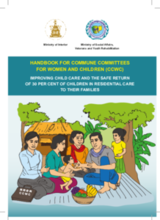
This handbook highlights the role commune committees for women and children (CCWCs) can play in support of implementing the Action Plan for improving child care, which is being carried out in five priority provinces in Cambodia. The Action Plan intends to safely return 30 per cent of children in residential care to their families by the end of 2018, as well as establish effective preventive and gatekeeping mechanisms to prevent unnecessary family separation. This handbook is useful in strengthening CCWCs’ roles and enhancing their knowledge and capacity to protect children in their communes.
Using the Attachment Theory as a guiding framework, this study sought to explore the effects of prolonged residential care for children.
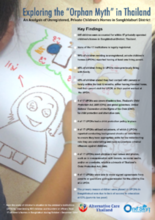
This summary report presents key findings and recommendations from an analysis of unregistered, private children's homes in Thailand's Sangkhlaburi District.
This dissertation study aimed to describe and understand adolescent girls’ subjective experiences of life in an after-care facility after transitioning out of institutionalized care in Delhi, India.