File
Displaying 1 - 10 of 164
This article examines the growing concerns around child-headed households in Zambia as disruptions to HIV treatment access leave some parents unable to continue receiving life-saving medication.
This large-scale study across eight African countries finds that the Parenting for Lifelong Health programme is associated with significant reductions in physical and emotional abuse, improved parenting practices, and better mental health outcomes for both caregivers and adolescents. It demonstrates that evidence-based parenting interventions can be effectively delivered at scale—even in humanitarian contexts—while maintaining strong positive impacts.
The UNICEF Caring for the Caregiver package is a counselling approach and behaviour change intervention that can be integrated into routine home-visiting by frontline workers, in a demand-responsive way, at a population level. This study aimed to evaluate caregiver outcomes and explore intervention experiences from the package in six low-income and middle-income countries.
This study explores why street children resist removal interventions and often return to the streets in Zambia, drawing on perspectives from children, caregivers, and guardians. It finds that factors such as poverty, family conflict, abuse, and inadequate conditions in care facilities drive both initial street involvement and reintegration failure, highlighting the need for more comprehensive and coordinated interventions.
This Social and Behaviour Change (SBC) Plan outlines Zambia’s strategic approach to strengthening child protection through behaviourally informed programming and community engagement. Developed by the Ministry of Community Development and Social Services with support from UNICEF and partners, the plan focuses on reducing violence against children, preventing child marriage, increasing birth registration, and promoting family-based care.
This article examines how national care systems for orphans and vulnerable children in Cambodia, Uganda, and Zambia are governed, drawing on case studies and a review of existing research. It highlights the gap between strong policy commitments and weak on-the-ground implementation, pointing to historical, political, and capacity-related factors that hinder effective care and protection.
This evaluation of Save the Children Finland’s Child-Sensitive Social Protection (CSSP) programme (2022–2025) found that it improved access to social protection, strengthened government systems, and supported better parenting practices across six countries in Africa and Asia. The programme showed strong results—especially through its parenting component, which improved caregiver engagement and child development outcomes—while highlighting the need for greater government ownership to sustain long-term impact.
A strong social service workforce (SSW) is the backbone of effective child protection systems. Across Eastern and Southern Africa, social service workers play a critical role in preventing and responding to violence, abuse, neglect, and exploitation of children. Yet, the workforce remains underfunded and understaffed, limiting its ability to deliver essential services. To address this gap, UNICEF Eastern and Southern Africa Regional Office (ESARO) has developed this Synthesis Report , providing a detailed guide to developing an investment case, drawing on lessons from Kenya and Zambia.
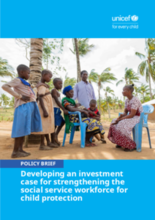
A strong social service workforce (SSW) is the backbone of effective child protection systems. Across Eastern and Southern Africa, social service workers play a critical role in preventing and responding to violence, abuse, neglect, and exploitation of children. Yet, the workforce remains underfunded and understaffed, limiting its ability to deliver essential services. To address this gap, UNICEF Eastern and Southern Africa Regional Office (ESARO) has developed this Policy Brief summarizing the rationale and approach for building an investment case for strengthening the SSW.
This case study describes how ACE Zambia transitioned from providing residential care in Zambia to pioneering family-based care, including foster care, and supporting other residential care service providers to transition.