Manifeste pour une Éthique de l’Adoption Internationale
Le Service Social International lance son Manifeste pour une éthique de l’adoption internationale.
Le Service Social International lance son Manifeste pour une éthique de l’adoption internationale.
The International Social Service (ISS) has launched its Manifesto For Ethical Intercountry Adoption. The Manifesto seeks to promote ethical practices by all adoption stakeholders to better protect children, whether in the receiving country or country of origin, including inter alia, biological parents, adoptive parents, professionals and government representatives.
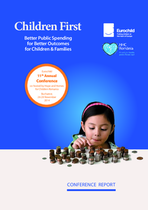
This report summarizes the discussions and activities held at Eurochild’s 11th Annual Conference, co-hosted by Hope and Homes for Children in Bucharest, Romania on 26-28 November 2014.
This caregiver guide, which accompanies an illustrated children’s book, is written for the caregivers of children affected by the Ebola crisis.
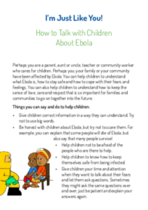
This downloadable children’s book, accompanied by a caregiver guide, is written for the children affected by the Ebola crisis, their caregivers and communities.


This video briefly recaps the Africa-Wide Children without Appropriate Care Program Learning Event hosted by Save the Children in Addis Ababa, Ethiopia, on 20-23 April 2015.
This article examines an alternative approach to child protection which consists of community-driven, bottom-up work that enables nonformal–formal collaboration and alignment, greater use of formal services, internally driven social change, and high levels of community ownership. The article offers a case example of a community-driven program in Sierra Leone.
Esta evaluación rápida, conducida por RELAF in colaboración con Save the Children y UNICEF, revisa las políticas públicas y servicios desarrollados por instituciones gubernamentales y no-gubernamentales perteneciendo al "Sistema de Protección Integral" para hacer frente a las cuestiones problemáticas que afectan los niños migrantes y sus familias en el Triángulo del Norte (El Salvador, Guatemala, y Honduras) y México.
Este informe está dirigido a sintetizar conceptos fundamentales y normas relativos a la protección de los derechos de los niños migrantes y adolescentes en el Triángulo Norte de Centroamérica.
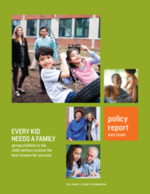
This KIDS COUNT policy report highlights the benefits of family care for children and the need to prioritize family settings for all children in the child welfare system in the United States.