Different sizes, similar challenges: Out of home care for youth in Germany and the Netherlands
This article reviews the history and development of out-of-home care services in Germany and the Netherlands comparing trends and numbers.
This article reviews the history and development of out-of-home care services in Germany and the Netherlands comparing trends and numbers.
This article provides an overview of the current situation in the out-of-home care in Norway and Sweden. Development in later years is described and discussed, including the trends towards privatization of the welfare system in both countries and the role of private, commercial actors within the care sector including out-of-home care for children and young people.
There has been a significant growth in the use of formal kinship care in the UK and Ireland in the last 20 years. The paper charts some of the reasons for the 'organic growth' of kinship care and the multiple dynamics that have shaped this.
This article provides an outline of the early development of care and protection in Australia and New Zealand as a backdrop to an overview of child protection systems and policies and the current child protection profile in both countries. An overview of trends in relation to out of home care, including routes into care, care arrangements and permanency policies is provided.
This paper provides overview of the US and Canada in-care system, noting certain differences and similarities between the two systems. Estimates of the number of children in care in Canada and data on children in the US foster care systems is also provided.
This article closes a special edition focused on the state of child protection in 16 countries chosen to represent very different cultural contexts, historical backgrounds, and social welfare systems with special attention to out-of-home care placements, principally family foster care and residential care, though several aspects related to adoption were included as well.
The objective of this study was to investigate which model of care and support is more appropriate for improving psychosocial and economic security of AIDS orphans in Nepal.
For this study conducted in and near Kampala, Uganda, 518 youth (8 to 18 years old) and their caregivers were interviewed individually, examining the association between relatedness and perceived food and work equity, and school attendance.
This powerful chart illustrates preliminary research findings using data from Demographic and Health Surveys (DHS) in 5 African countries (Malawi, Mozambique, Niger, Uganda and Zimbabwe) to better understand how orphan status affects the school attendance of children in Africa and the extent to which living in kinship care can act as a protective factor in this context.
This systematic review published by the Campbell Collaboration reviewed controlled experimental and quasi experimental studies in which children removed from the home for maltreatment and subsequently placed in kinship care were compared with children placed in non-kinship foster care for child welfare outcomes in the domains of well-being, permanency, or safety.
This Handbook aims to provide guidance for Save the Children staff, NGO partners, Community Child Protection Groups and community volunteers in Myanmar in protecting the welfare of children living with extended family members.
This comprehensive policy report by the Annie E. Casey Foundation summarizes what is known about kinship care in the United States, identifies the problems and issues these families face, and recommends how best to support caregivers as they step up to take responsibility for children in their extended families and communities.

This position statement by Save the Children highlights the central place of families in numerous international legal instruments and how the concept has been understood. It also clarifies its own understanding of families and reviews key provisions under international law regarding their crucial role and responsibilities, and that of States towards them.
This important report documents a 22-month longitudinal study of the reintegration of children in residential care in Moldova.
This webinar presentation by Professor Marie Connolly of the University of Melbourne introduces the history and background of Family Group Conference (FGC) in New Zealand and Australia and discusses the influence of FGC on the development of formal or statutory kinship care in the region.
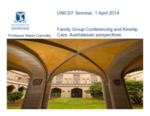
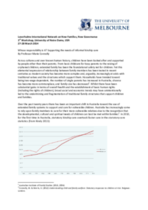
In this presentation Professor Connolly reviews recent trends in the use of kinship care in Australia and discusses what this shift means in the context of the ‘residual’ model of child protection used in the country.
This country care review includes the care related Concluding Observations adopted by the Committee on the Rights of the Child as part of its examination of the fourth periodic report of Yemen under the Convention on the Rights of the Child at its sixty-fifth Session (13 Jan 2014 - 31 Jan 2014).
This country care review includes the care related Concluding Observations adopted by the Committee on the Rights of the Child and the Committee on the Rights of Persons with Disabilities.
This country care review includes the care related Concluding Observations adopted by the Committee on the Rights of the Child and the Committee on the Rights of Persons with Disabilities.
This country care review includes the care related Concluding Observations adopted by the Committee on the Rights of the Child as part of its examination of the combined second to fourth periodic report of the Congo under Convention on the Rights of the Child at its sixty-fifth Session (13 Jan 2014 - 31 Jan 2014).
This country care review includes the care related Concluding Observations adopted by the Committee on the Rights of the Child and the Committee on the Rights of Persons with Disabilities.
This country care review includes the care related Concluding Observations adopted by the Committee on the Rights of the Child as part of its examination of the second periodic report of the Holy See under Convention on the Rights of the Child at its sixty-fifth Session (13 Jan 2014 - 31 Jan 2014).
This video by Save the Children highlights the major reforms ongoing in Georgia to end harmful child institutionalisation and the work of its project to support the Government in this reform process.
This leaflet is a mapping of Save the children’s role and work in promoting the engagement of fathers. It presents some of the evidence of the benefits of involving fathers and some of the strategies used by the organization and others.
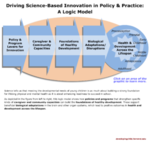
This narrated interactive feature presents a logic model showing how policies and programs that strengthen specific kinds of caregiver and community capacities can build the foundations of healthy development.