
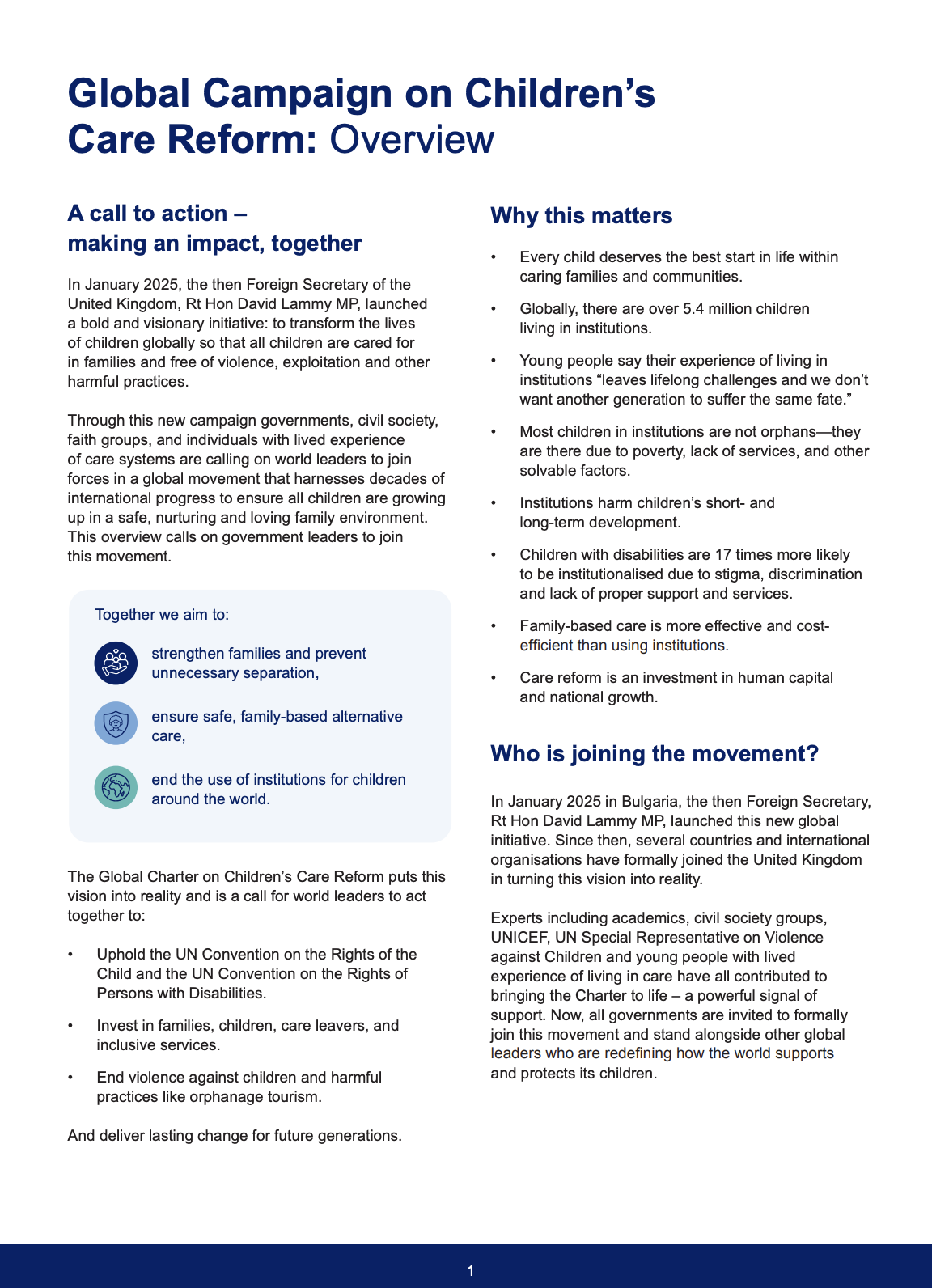
In January 2025, the U.K. Foreign, Commonwealth and Development Office (FCDO) initiated a global campaign to mobilize political will and coordinated action toward transforming care for children around the world. Through this new campaign, governments, civil society, faith groups, and individuals with lived experience of care systems are calling on world leaders to join forces to ensure all children are growing up in a safe, nurturing, and loving family environment.
Together, they aim to:
- strengthen families and prevent unnecessary separation
- ensure safe, family-based alternative care
- end the use of institutions for children around the world
Global Charter on Children's Care Reform
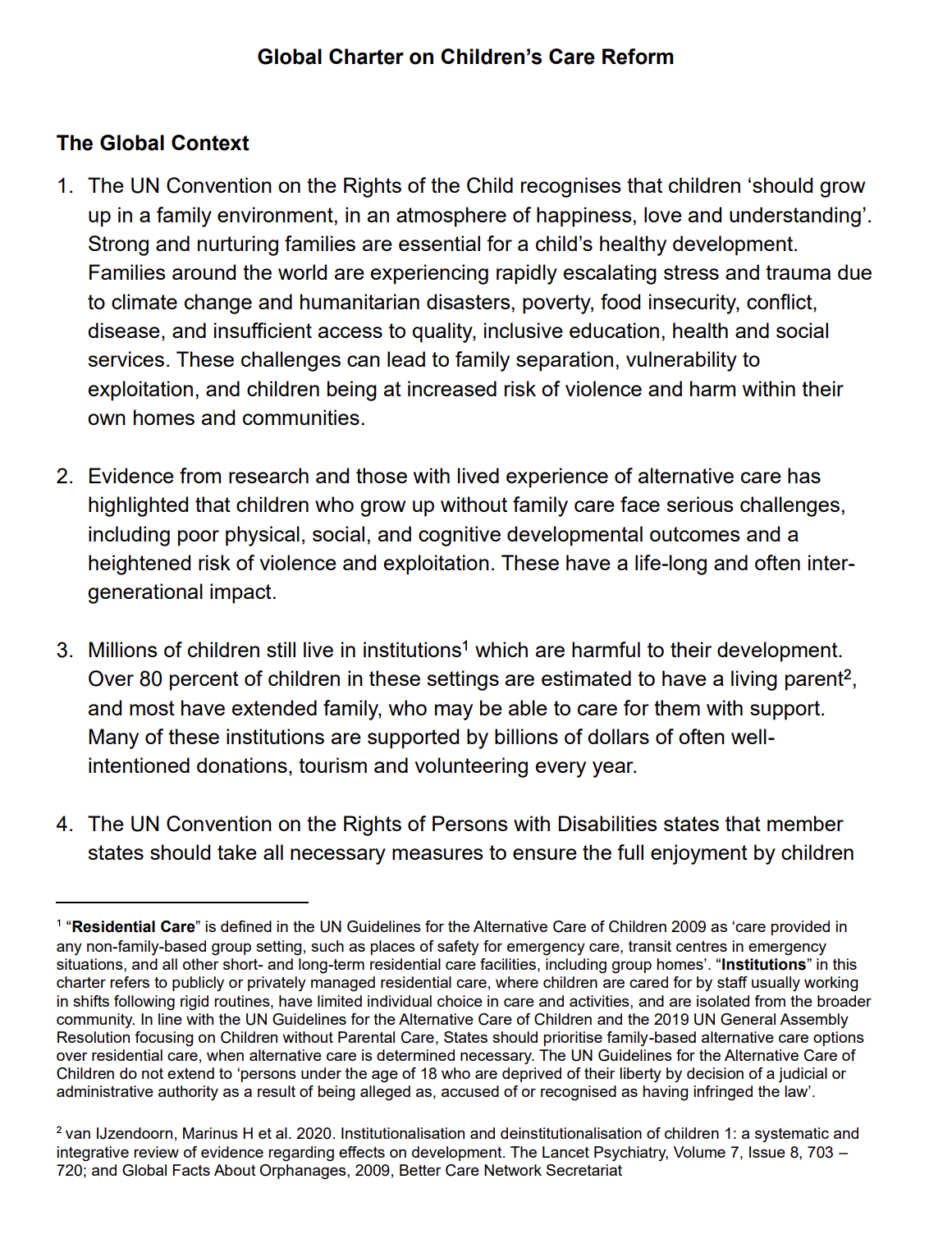 A key component of the Global Campaign is the Global Charter on Children’s Care Reform. The Charter builds on existing international commitments and calls for urgent, multi-sectorial action to transform care for children worldwide. All national governments are invited to sign the charter and follow through on their commitments with meaningful investment and implementation. Civil society organisations and inter-governmental bodies are encouraged to formally endorse the Charter as a visible demonstration of their support for transforming care for children worldwide.
The Charter is available in English, Spanish, French, and Arabic.
View the list of participating states and organizations
What the Charter Calls For
The Charter is open for signature by ALL national governments. By signing the Charter, governments commit to:
- Upholding the UN Convention on the Rights of the Child and the UN Convention on the Rights of Persons with Disabilities.
- Investing in families, children, care leavers, and inclusive services.
- Ending violence against children and harmful practices like orphanage tourism.
Charter signatories are encouraged to:
- Demonstrate leadership by implementing the Charter’s objectives and commitments in ways that reflect national priorities and local realities.
- Join a global movement of governments working together to drive transformative change, amplifying your country’s voice and influence on the world stage.
- Inspire and be inspired across countries by sharing experiences, progress, and lessons learned, helping shape more effective interventions and investments around the world.
- Define the country’s own priorities and commitments to advance family care for all children within its national context.
- Participate in periodic learning events and exchanges to showcase their progress and to learn from peers. While there is no mandatory financial contribution, countries are encouraged to mobilise the necessary resources to deliver on their commitments.
Why Sign
Charter signatories are both reaffirming commitments already made and making new pledges/commitments to act. Countries that sign the Charter will:
- be recognised as a champion on this issue and have a global stage to showcase achievements and successes
- access global best practices and peer learning
- be eligible for technical assistance from FCDO-funded experts
- be invited to networking and learning events amongst other global leaders
Overall, countries will benefit from the transformative impacts that safe and nurturing family-based care can have including on poverty reduction, strengthening human capital and bolstering state and community resilience.
Process to Sign or Endorse
- All national governments are invited to stand alongside other global leaders by signing the charter—and by following through on their commitments with meaningful investment and implementation. Ministries can confirm support by sending a note verbale (or Ministerial-level letter) to the U.K. Mission in their country.
- Civil society organisations and inter-governmental bodies are encouraged to formally endorse the Charter as a visible demonstration of their support for transforming care for children worldwide. To endorse the Charter, send a brief email or letter from the head of your organisation to: ChildrensCareReformCampaign@fcdo.gov.uk
Background on Children's Care and How it Can be Strengthened
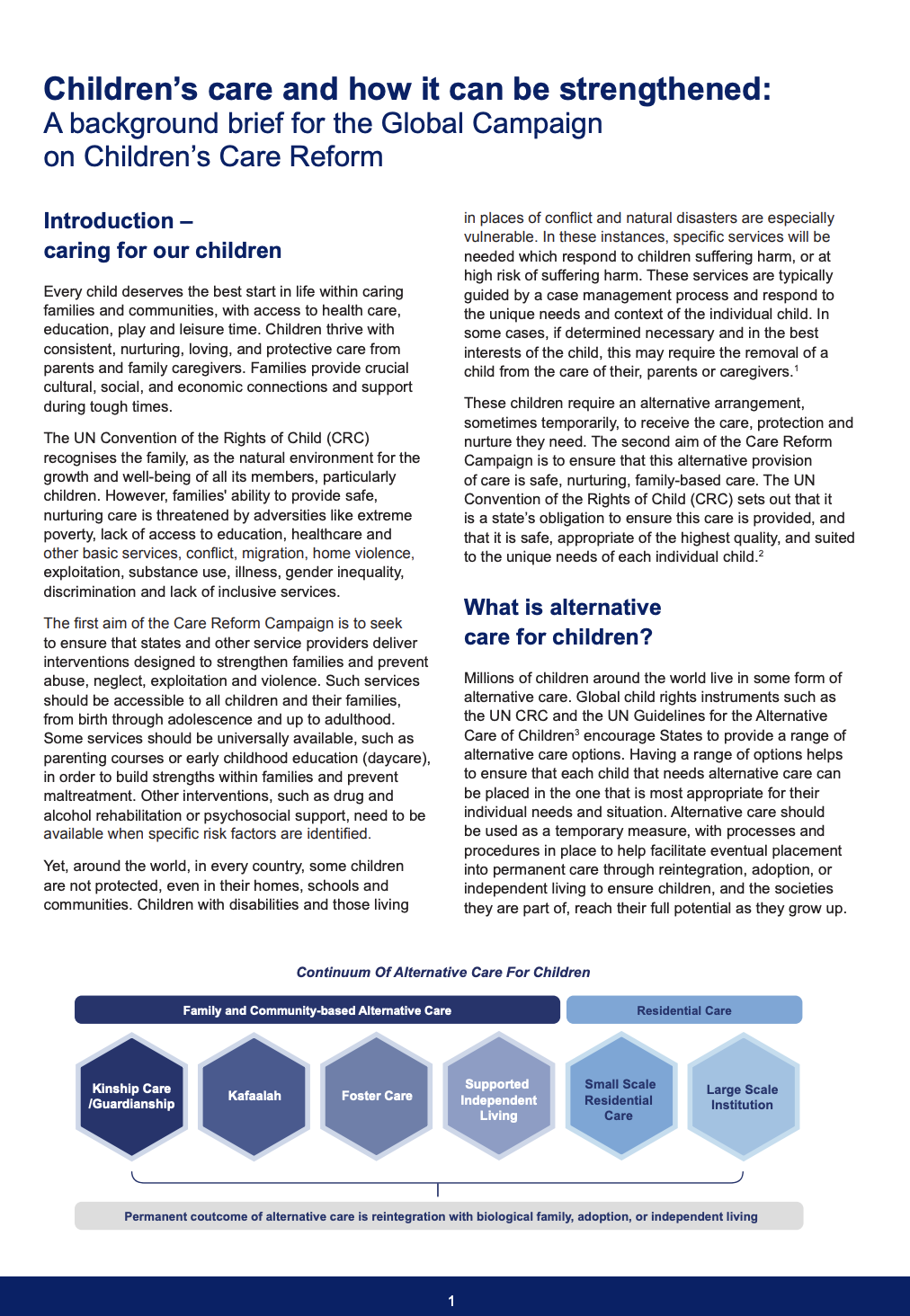
The following documents have been developed to support those engaging technically with the Global Campaign of Children’s Care Reform by providing an overview of care reform as well as a deeper exploration of key themes introduced in the Global Charter on Children’s Care Reform. "Children's Care and How it Can be Strengthened" serves as an introductory brief of care reform and "Technical Insights on Children's Care focuses more on detailed, nuanced, and context-specific issues that arise in care reform efforts across diverse contexts, countries, and systems.
Technical Insights on Children's Care
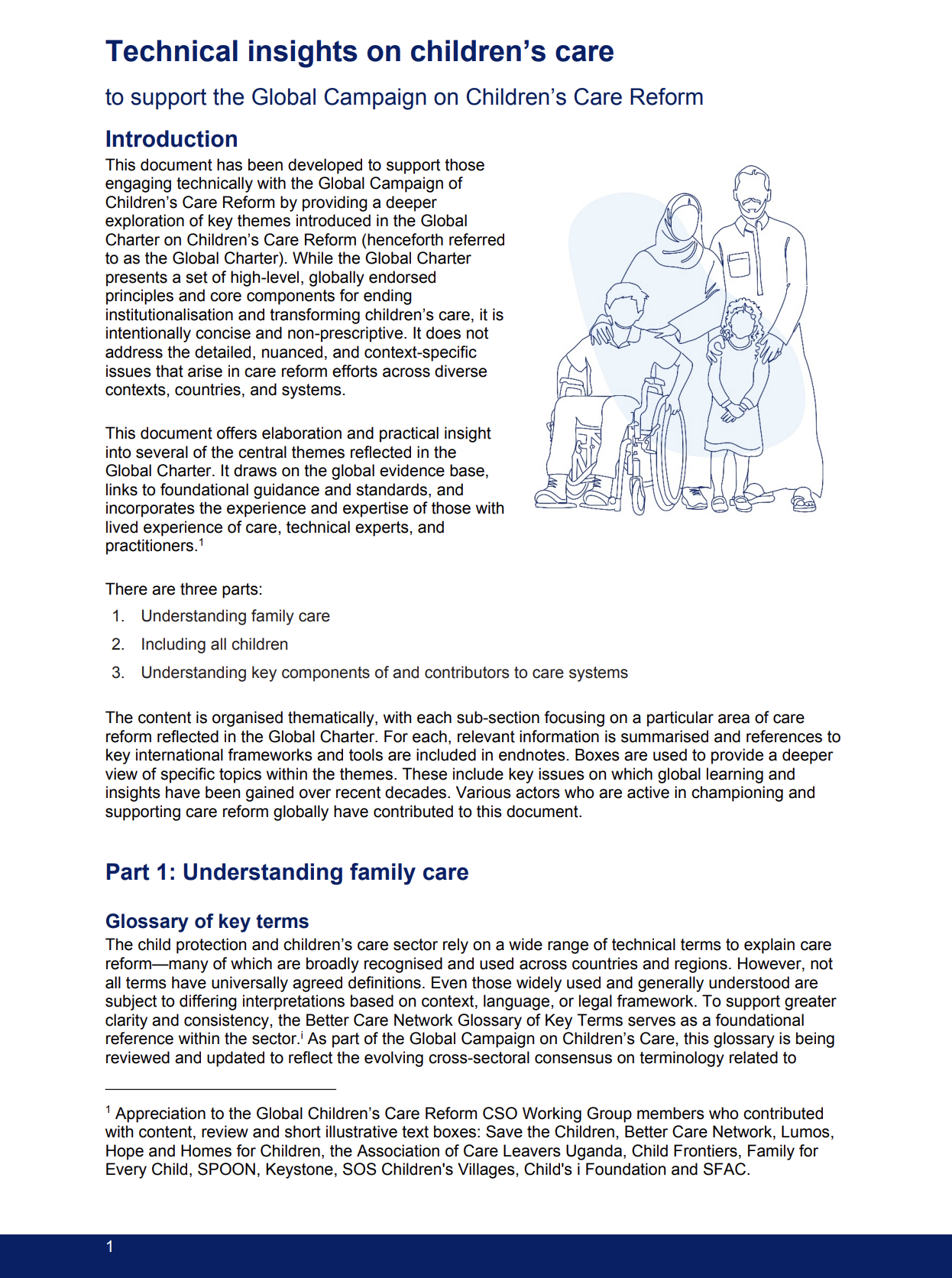
While the Global Charter presents a set of high-level, globally endorsed principles and core components for ending institutionalisation and transforming children’s care, it is intentionally concise and non-prescriptive. It does not address the detailed, nuanced, and context-specific issues that arise in care reform efforts across diverse contexts, countries, and systems. An additional document has been developed to support those engaging technically with the Global Campaign by providing a deeper exploration of key themes introduced in the Global Charter on Children’s Care Reform. It draws on the global evidence base, links to foundational guidance and standards, and incorporates the experience and expertise of those with lived experience of care, technical experts, and practitioners.
It focuses on three parts:
- Understanding family care
- Including all children
- Understanding key components of and contributors to care systems
This document is available in English.
Campaign Resources
The U.K. Foreign, Commonwealth and Development Office, alongside global partners, have developed the following resources to help countries develop commitments and request technical assistance.
Developing Commitments
Governments that sign the Charter are encouraged to develop commitments, based on the specific context in which they work, which define specific actions towards long-term solutions for the safe and nurturing care of all children. All other actors, including inter-governmental and non-governmental organisations, are encouraged to support governments to develop and implement commitments.
What are Commitments?
Commitments are specific actions that countries agree to implement and monitor, in order to put into action the key principles set out in the Charter, focusing on any of the following:
- Support families to prevent unnecessary family separation, ensuring safe and nurturing familybased alternative care and progressively ending the institutionalisation of all children
- Call out and tackle harmful and unacceptable practices
- Increase financial resources and addressing issues that contribute to the placement of children in institutions
- Invest in key enablers to support improved social services to support a family for every child
- Defend children’s rights and learning from those with lived experience
Recognising that countries will be at different stages of their care reform journey, commitments should be context specific and driven by the priorities and resources of the country. Countries are encouraged to reach for the highest standard possible relative to the context in which they operate.
Guidance on Developing Commitments
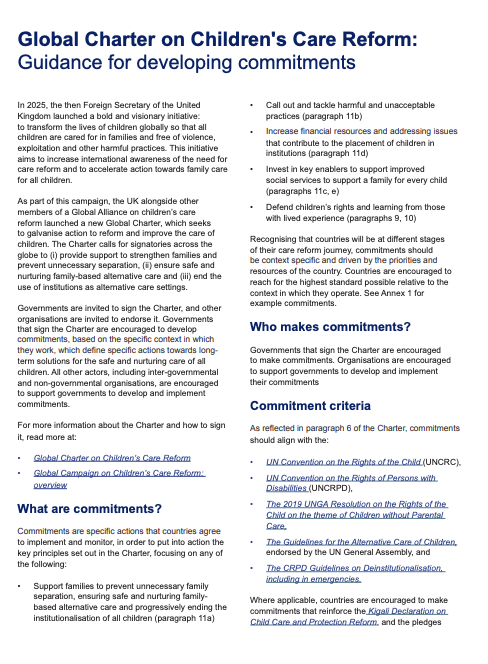 Guidance has been created to support governments in designing ambitious, measurable, and context-specific commitments that align with the Charter’s principles. It includes practical criteria, examples, and participatory approaches to ensure commitments are realistic, well-resourced, and responsive to children’s needs.
View the Guidance: English, Spanish, French, and Arabic.
Video on Developing Commitments
The video below provides an overview of the Guidance for Developing Commitments. The video is also available in Spanish, French, and Arabic.

Requesting Technical Assistance
Countries that sign the Charter are encouraged to make their own commitments describing specific actions they will take to realise the aims of the Charter. To support governments to develop and/or implement their commitments, Maestral International, with the support of the UK Foreign, Commonwealth and Development Office, is coordinating the provision of technical assistance.
There are two types of technical assistance (TA) available:
- Technical assistance to develop commitments: Government signatories may request technical assistance from care reform advisors to support the development of robust and ambitious commitments. For example, support could include:
- Conducting or facilitating assessments of care systems, including support to use the Global Campaign Care System Assessment tool;
- Facilitating participatory processes and consultations;
- Guidance on evidence and best practice;
- Providing a technical review of commitments ahead of submission.
- Technical assistance to implement commitments: Technical assistance can also be requested after commitments have been made. The purpose of this support is to provide mentoring and expert guidance from global, regional, and national care reform specialists to help advance the implementation of commitments. Technical assistance is not intended to outsource the delivery of commitments. Instead, the assistance can provide direction, tools, and resources to guide and build capacity in your efforts to deliver high-quality implementation.
Guidance on Requesting Technical Assistance
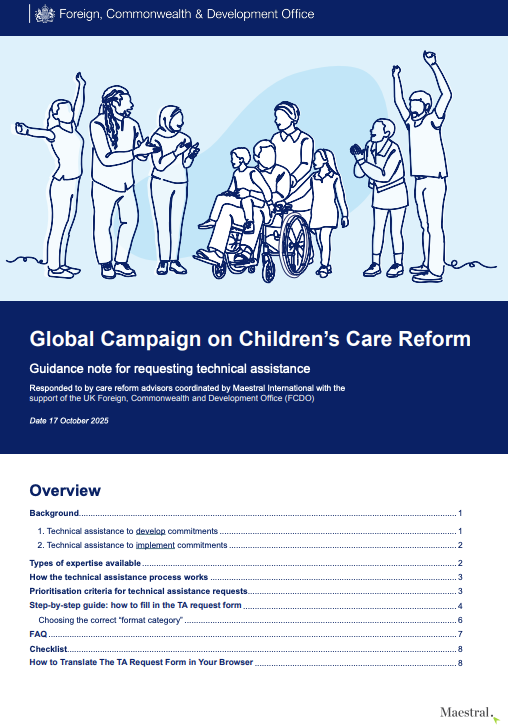
Guidance has been developed to provide instructions on how governments can request technical support from a team of care reform advisors to develop or begin implementing those commitments. This includes a description of the different types of technical assistance available, ways it can be provided, and a step-by-step guidance for submitting requests.
The Guidance is available in English, Spanish, French, and Arabic.
Video on Requesting Technical Assistance
This video provides a short overview on requesting technical assistance. This video is also available in Spanish, French, and Arabic.

Wilton Park Event
From 28–30 January 2026, fifty representatives from governments, civil society, faith-based organisations, UN agencies, academia, and young people with experience of care gathered at Wilton Park in the UK to discuss how the Global Campaign for Children’s Care Reform can move from commitment to collective action. Participants shared learning, challenged assumptions, and identified practical pathways to systemic change. The discussions will inform the setting of priorities for a Global Campaign roadmap that will articulate the objectives, activities and strategies for the campaign to leverage the momentum and energy of existing care reform efforts and to propel action on children’s care reform further into the spotlight. This report provides an overview of the dialogue.
The report is available in English.
Global Campaign Working Group
A Working Group has been established under the Transforming Children’s Care Collaborative to provide strategic, high-level inputs to the development and implementation of the Global Campaign on Children's Care Reform. Learn more about the Working Group and how to join, below.
Purpose of the Working Group
The working group ensures the facilitation, consultation, and collaboration between a wide range of civil society, UN agencies, networks of individuals with lived experience of care, and the UK Foreign, Commonwealth & Development Office, with the aim of shaping and contributing to successful global outcomes on care reform. The group is civil society-led and provides independent support and technical leadership to the campaign.
The group is co-convened by Better Care Network, Hope and Homes for Children, Save the Children, and UNICEF.
How to Join
Membership in the Working Group is inclusive and open to all stakeholders with relevant expertise and capacities to contribute to fulfilling the objectives of the group.
To become a member of the Working Group:
- Become a member of the Transforming Children’s Care Collaborative
- Navigate to the Global Campaign on Children's Care Working Group
- Select "Request to Join."