
DataCare Project Technical Report: Better data for better child protection systems in Europe - Mapping how data on children in alternative care are collected, analysed and published across 28 European countries
This report was conceptualised jointly by Eurochild and the UNICEF Europe and Central Asia Regional Office (ECARO) and builds on the Eurochild report on alternative care in Europe published in 2009. It also includes a full set of country profiles.
File
DataCare Project Policy Brief: Children in alternative care - Comparable statistics to monitor progress on deinstitutionalisation across the European Union
This policy brief summarises the policy context, as well as the key findings and recommendations from the analysis of the national responses to the DataCare survey across Europe. More detailed information can be found in the full research report: Better Data for Better Child Protection Systems in Europe: Mapping how data on children in alternative care are collected, analysed, and published across 28 European countries, which includes a full set of country profiles.
File
The DataCare Project
The DataCare Project was launched by Eurochild with support from UNICEF in March 2020. The project aims to carry out a comprehensive mapping of child protection data systems across the 27 Member States of the European Union (EU) and the UK. In addition to providing an overview of the situation of children in alternative care in Europe, this project aims to inform EU efforts to agree to comparable benchmarks and indicators to monitor progress in child protection reforms across Europe.
Image
Toolkit for Disability Inclusion in Care Reform: Understanding Disability Inclusion Training (Workshop Slides)
These slides were designed by disability and care reform practitioners and consultants for CTWWC with an aim to build the capacity and confidence of those working in family strengthening and children’s care for work with children with disabilities and their families. These slides are designed to be used by the person providing the workshop, often called “the facilitator” or “the trainer”.
Toolkit for Disability Inclusion in Care Reform: Understanding Disability Inclusion Training Resources
The Facilitator Manual for Understanding Disability, a training in disability inclusion, and the accompanying slides were designed by disability and care reform practitioners and consultants for CTWWC with an aim is to build the capacity and confidence of those working in family strengthening and children’s care for work with children with disabilities and their families.
Toolkit for Disability Inclusion in Care Reform: Understanding Disability Inclusion Training (Facilitator’s Manual)
This facilitator’s guide accompanies the workshop slides by the same title, Understanding Disability. It is designed to be used by the person providing the workshop, often called “the facilitator” or “the trainer”. It is suggested that participants familiarize themselves with other resources in the Toolkit for Disability Inclusion in Care Reform as a foundation for this workshop. Each session section of this guide provides the facilitator with a script; however it should not be read verbatim but rather adjusted to the facilitator’s own style. Scripts will appear in italic font. The section description includes content for lecture with accompanying slides, suggested handouts, and exercises.
File
Toolkit for Disability Inclusion in Care Reform: Participation & Advocacy Learning Workshop Resources
The Facilitator Manual for the Participation & Advocacy Learning Workshop and the accompanying slides were designed by disability and care reform practitioners and consultants for CTWWC with an aim is to build the capacity and confidence of those working in family strengthening and children’s care for work with children with disabilities and their families.
Toolkit for Disability Inclusion in Care Reform: Participation & Advocacy Learning Workshop (Facilitator's Manual)
The Facilitator Manual for the Participation & Advocacy Learning Workshop and the accompanying slides were designed by disability and care reform practitioners and consultants for CTWWC with an aim is to build the capacity and confidence of those working in family strengthening and children’s care for work with children with disabilities and their families.
File
Готовность воспитанников организаций для детей-сирот к самостоятельной жизни: подходы к оценке и организации (Readiness for Independent Life in Children from Orphan Organizations: Approaches to Assessment and Promotion)
Представлен обзор проблемы готовности сирот к самостоятельной жизни. Показано, что внешние детерминанты готовности к самостоятельной жизни связаны со спецификой взросления сирот и находятся в исследовательском поле социальной адаптации выпускников детских домов.
Low readiness for independent living is what underlies the problems of social adaptation in children and adolescents from orphan organizations. This review explores how scientists and practitioners interpret this very concept of readiness for independent living.
File
Call to Action: Prioritizing sleep health among US children and youth residing in alternative care settings
The goal of this Call to Action is to draw attention to the sleep health of children residing in alternative care settings. It highlights the need for a more robust evidence base to address major knowledge gaps and outline concrete steps toward building future promising sleep health-promoting practices and policies supporting children residing in alternative care settings.
Image

Forcibly Displaced Children: Children refugees, internally displaced persons (IDPs) and/or forced migrants
The purpose of this evidence synthesis is to analyze the primary and secondary impacts of the pandemic on children who are refugees, IDPs and/or migrants and highlights important protective factors and emerging response measures identified in a review of recent news media, project reporting, academic research and other relevant resources mapped over the previous five-month period.
File
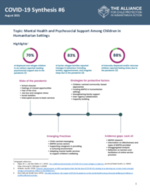
Mental Health and Psychosocial Support Among Children in Humanitarian Settings
The purpose of this evidence synthesis is to summarize what is already known about the impacts of the pandemic on children’s mental health risks, specifically in humanitarian settings with the aim of providing an overview of evidence to date. This synthesis captures the toll that COVID-19 and public health measures to reduce its transmission have taken on children’s mental health worldwide due to stressors from social isolation, family hardships, school closures, service interruptions, and economic crises. Evidence relevant to mental health and psychosocial support generally and in conflict-affected settings were included. Together, 52 academic articles and resources and 21 news articles from April 2020 to July 2021 were compiled for this report.
File
The Aftermath of Transnational Illegal Adoptions: Redressing human rights violations in the intercountry adoption system with instruments of transitional justice
A growing movement of illegally adopted individuals request remedies and reparations for the human rights violations that they and their biological families had suffered. This article explores a number of measures that the stakeholders in the receiving countries can use in an effort to repair the human rights violations caused by illegal intercountry adoptions, borrowing ideas from transitional justice. In order to effectively redress the harm inflicted upon victims of illegal adoptions, a policy on remedies should combine instruments of retributive justice, aimed at holding wrongdoers accountable, with measures of restorative justice that focus on the victims’ needs and interests.
File
Pandemic Ethics: Rethinking rights, responsibilities and roles in social work
This article explores responses of 41 UK social workers to ethical challenges during the COVID-19 pandemic, utilising UK data from an international qualitative survey and follow-up interviews in 2020. Challenges ranged from weighing individual rights/ needs against public health risks, to deciding whether to follow government/agency rules and guidance.
File
Child Abandonment and the Question of Child Rights: a study of Skolombo boys and Lakasara girls of Calabar, cross rivers state, Nigeria
This study examined the reasons for the pervasiveness of the practice of child abandonment, using the “Skolombo Boys and Lakasara Girls’’ in Calabar, the state capital of Cross River State, Nigeria, as the analytical context.
File
Shifting Landscapes of Global Child Mental Health: Imperatives for transdisciplinary approaches
There are a multitude of stakeholders involved in the protection, education, mental health and psychosocial care of children for children in low- and middle-income countries. This article presents how the current medical and public health models for child mental healthcare, do not adequately address the complexities of child protection and mental health. It argues for mental health professionals to: (a) recognise the role of Adverse Childhood Experiences (ACEs) in mental health morbidity; (b) adopt an alternative approach, namely that of transdisciplinarity, to enable more effective solutions to children’s psychosocial and mental health issues, through systemic reform and transformation.
Image

Exploring the Impact of the Absence of Parents on the Left-Behind Children and Its Countermeasures
"Left-behind children" refer to children whose parents or one of them go out to work in the city all year round. Due to the education conditions in the city, they stay alone in the countryside. Because they are separated from their parents all the year round, the lack of good family education in their growth environment has brought many negative effects on their growth and also caused more serious social problems. It can be seen that the research on the family education of left-behind children in rural areas is very necessary. Therefore, this study takes G Village in Guizhou Province as an example. This study includes literature review and a interview of 40 left-behind children and 20 guardians in G Village, Guizhou Province. Also, the physical and mental health and safety hazards of left-behind children and their causes were analyzed.
File
Социальные установки выпускников детских (интернатных) учреждений в отношении будущего (Social Attitudes Towards the Future in Graduates of Orphan Organizations)
Отмечается, что, несмотря на усилия государства и некоммерческих организаций (далее – НКО), сохраняются проблемы адаптации детей-сирот к интеграции в социум. Обращается внимание на тот факт, что исследование речевых поведенческих моделей выпускников детских институциональных учреждений (ЦССВ, ЦССД) некоторых некоммерческих организаций выявляет антиномичность их программ друг другу и исходным целям. Объектом этих противоречий выступает процесс формирования зависимых социальных установок детей-сирот. Задача проведенного авторами исследования – выявить социальные установки выпускников детских (интернатных) учреждений, касающиеся собственной траектории социальной и профессиональной адаптации, и сопоставить, насколько выявленным установкам соответствуют существующие программы постинтернатной адаптации, реализуемые НКО.
Despite the efforts of the state and non-profit organizations (hereinafter — NPOs), the problems of orphans’ adaptation and integration into the society persist. Studies of speech behavioral models in graduates of child care institutions of some non-profit organizations reveal the antinomic nature of their programs and goals. These contradictions revolve around the process of formation of dependent social attitudes in orphaned children. The task of this research is to assess the role that NPOs play in the formation of certain social attitudes of graduates of child care (boarding) institutions (ex-orphanages).
File
One Year Into COVID-19: What have we learned about child maltreatment reports and child protective service responses?
This study is part of a larger initiative using an international platform to examine child maltreatment (CM) reports and child protective service (CPS) responses in various countries. The first data collection, which included a comparison between eight countries after the pandemic's first wave (March–June 2020), illustrated a worrisome picture regarding children's wellbeing. The current study presents the second wave of data across 12 regions via population data (Australia [New South Wales], Brazil, United States [California, Pennsylvania], Colombia, England, Germany, Israel, Japan, Canada [Ontario, Quebec], South Africa).
File
Strengthening Caregiving Environments: Prioritising Family-based Care in Humanitarian Settings During COVID-19
Understanding the risks and responses to children’s caregiving environment during COVID-19 remains limited. This is especially the case in humanitarian settings. This brief, therefore, aims to report what is known so far during the pandemic. The brief focuses on strategies to strengthen the caregiving environment through family- and community-based approaches. It also offers a series of case studies from various humanitarian and emergency contexts.
File
Virtual Exchange Program on Foster Care: Sharing systems, experiences and best practices to implement and strengthen Foster Care services in Kenya and Italy
The Kenya-Italy “Virtual Exchange Program on Foster Care” aims to create a platform for learning, networking and sharing knowledge and best practices on Foster Care among different government stakeholders, from Kenya and Italy.
The exchange program took place on 5th, 7th and 9th July 2021.
File
Report 8: Analysis of the Regulatory Framework and Financing Mechanism for the Alternative Care System
The analysis was carried out in order to develop practical recommendations on improving the regulatory framework and the social services financing mechanism to prevent the separation of children from families and support alternative care mechanisims.
File
Report 7: Findings from Child Assessments from 6 Residential Institutions
The purpose of the individual assessment of 184 children in six RIs was to collect up-to- date information on the demographics, as well as the social, educational, psychological, and medical status, of children placed in RIs in order to plan their reintegration into their families of origin and/or to prepare them to transition from residential to family care.
File
Report 5: Knowledge, Attitudes, and Practices of Reintegrating Children into Families
The study aims to develop specific practical recommendations for changing the knowledge, attitudes, and practices of the target groups in order to prevent child-family separation and remove existing obstacles children and families face during reintegration.
File
Report 4: Analysis of National and International Best Practices in Case Management
The analysis of case management (CM) systems aims to contribute to the development of a CM model that both reflects the latest programmatic, legislative, and methodological developments at national and international levels, and effectively contributes to increasing the quality of services for vulnerable children and families.
File
Report 3: Assessment of Social Services for Vulnerable Children and Families
The aim of the study is to understand the current situation of social services focused on strengthening families’ capacity to provide a safe, stable, and nurturing environment for children, as well as services for children in need of, or currently in, alternative care and/or in the process of reintegration, in order to be able to formulate recommendations that will contribute to evidence-based decisions for their improvement.
File
Report 2: Situational Assessment of Child and Family Protection Personnel Training in the Republic of Moldova
The purpose of the evaluation is to strengthen the training program for child and family protection personnel in coordination with recent programmatic, legislative, and methodological developments at national and international levels, and to effectively contribute to improving the quality of services for vulnerable children and families by improving the competencies of professionals in the system.
File
Situational Analysis of Care Reform in the Republic of Moldova
This comprehensive situational analysis was comprised of seven unique pieces of research, conducted by individual researchers, research firms and CTWWC, and in close coordination the Government of Moldova. The research findings were presented to and validated during a process in which more than 140 participants representing 96 government bodies and NGOs participated in July 2021. All research is available in Romanian and English.
File
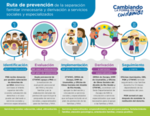
Ruta de prevención de la separación familiar innecesaria y derivación a servicios sociales y especializados
Esta Ruta de Coordinación, fue construida y diseñada de manera participativa y liderada por CTWWC Guatemala, con el objeto de articular de manera eficiente y coordinada los esfuerzos que los profesionales de las instituciones gubernamentales y municipales vinculadas a la prevención y proteccion, deben promover, gestionar y facilitar la derivación a los servicios sociales y especializados que permitan la prevención de la separación familiar innecesaria de los niños, niñas o adolescentes de su entorno familiar, basando las acciones en la metodología de manejo de casos y priorizando ante cualquier desición que se tome, la observacnia del interés superior del niño
File
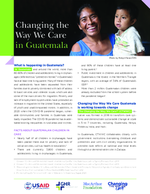
Changing the Way We Care in Guatemala
This two-pager highlights 2018-2020 results of the The Changing the Way We Care℠ (CTWWC) initiative for decision makers, government officials, media, other institutions or organizations working with children and adolescents, and private and public counterparts. CTWWC was formed in 2018 to transform care systems and demonstrate sustainable change at scale in 5 to 7 countries, including Guatemala, Kenya, Moldova, India, and Haiti. In Guatemala and around the world, more than 80-90% of children and adolescents living in orphanages (referred to as “protection homes” in Guatemala) have at least one living parent.
File
Herramienta de Evaluación de Modelos de Atención en Transición
Esta herramienta tiene como objetivo ayudar a los profesionales a lograr los siguientes objetivos al brindar apoyo técnico a las instituciones en transición:
File
Estudio de caso de una transición de alto riesgo: Lighthouse Children’s Village
La Aldea Infantil Lighthouse se estableció en 2004 como una institución de atención residencial de gestión privada y financiada con fondos privados. En 2014, su donante principal desde hace mucho tiempo tomó la decisión de eliminar gradualmente la atención institucional de apoyo financiero. Este estudio de caso destaca algunas de las señales de advertencia tempranas y el posterior descubrimiento de comportamientos no éticos y delictivos que a veces se pueden observar en un proceso de transición.
File

Estudio de caso del proceso del cambio: Haciendo la Transición del Orfanato Firefly
Este estudio de caso destaca algunas de las dinámicas clave que surgieron a lo largo del proceso de transición de sus servicios de la atención residencial a la programación no institucional de una organización y examina cómo esas dinámicas influyeron en la transición y determinaron el tipo de apoyo brindado, así como el más apropiado. estrategia de transición. El estudio de caso se organiza en torno a las distintas etapas de la transición y explora algunos de los temas clave descritos en la Herramienta de evaluación de modelos de atención en transición.
File
Estudio de caso de las condiciones que conllevan a una transició n segura: Bridges Safehouse
Este estudio de caso destaca algunos de los requisitos previos para el punto de partida de una transición exitosa de la atención residencial a un modelo no residencial, muchos de los cuales a menudo se pasan por alto o se subestiman. El estudio de caso se organiza en torno a las distintas etapas de la transición y explora algunos de los temas clave descritos en la Herramienta de evaluación de modelos de atención en transición.
File
Minimum Standards for the Care of Children in Residential Care Facilities
This document presents a set of minimum standards of care, which it is recommended that residential care facilities (RCFs) strive to adopt, particularly those RCFs engaged with or receiving support from CRS. The standards are designed to be applicable to a variety of residential care settings and are recommended to be used to promote care practices and approaches that contribute to positive child well-being.
File
Webinar Recording: COVID-19, Children, and Caregiver Loss
This panel discussed coronavirus-associated caregiver loss and the work being done by the international community, the U.S. government, and faith-based actors to support vulnerable children and turn the tide toward better care. It was moderated by Gillian Huebner, executive director of the Georgetown University Collaborative on Global Children’s Issues.
Hidden Pain: Children Who Lost a Parent or Caretaker to COVID-19
Among the more than 760,000 deaths from COVID-19 in the United States are parents, custodial grandparents, or other caregivers on whom children had relied for financial, emotional, and developmental support. Many of these children already faced significant social and economic adversity, and these devastating losses can impact their development and success for the rest of their lives. This report estimates the number of children who lost a parent or other caregiver to COVID-19 and provides concrete recommendations for urgent actions to protect these vulnerable children and their remaining caregivers.
File
Ending Corporal Punishment in the Early Years of Childhood: An Essential Right and Need of Every Child
This briefing, authored by Jorge Cuartas with End Violence and the Early Childhood Development Action Network examines evidence from research on the impacts of violent punishment on young children, global prevalence and progress towards universal prohibition, and strategies to end corporal punishment. It adds yet more weight to the call that all countries must take steps to prohibit and eliminate violent punishment of all children without delay.
File
Au-delà des soins en établissement: Feuille de route pour la réforme du système de protection et de prise en charge des enfants pour les gouvernements d’Amérique latine et des Caraïbes
Au-delà des soins institutionnels fournit un cadre aux gouvernements pour développer leur propre feuille de route pour la réforme et la désinstitutionnalisation du système de protection et de garde des enfants. Nous espérons qu'il inspirera une conversation, guidera le dialogue interministériel et interprofessionnel, soutiendra les groupes multidisciplinaires à tous les niveaux pour encadrer leur propre évaluation et planifier leur propre feuille de route pour le changement.
File
Más allá del cuidado institucional: Una hoja de ruta para la reforma del sistema de protección y cuidado infantil destinada a los Gobiernos de América Latina y el Caribe
Más Allá del Cuidado Institucional proporciona un marco para que los gobiernos desarrollen su propia hoja de ruta para la reforma de sus sistemas de protección y cuidado infantil y la desinstitucionalización. Esperamos que esto inspire el diálogo, guíe las conversaciones entre grupos interministeriales y en la sociedad, oriente a grupos
multidisciplinarios de todos los niveles en la creación de su propia evaluación y ayude en la planificación de su propia hoja de ruta para el cambio.
File
Beyond Institutional Care: A roadmap for child protection and care system reform for governments in Latin America and the Caribbean
This report provides a framework for governments to develop their own roadmap for child protection and care system reform and deinstitutionalisation. The authors hope that it will inspire a conversation, guide inter-ministerial and cross society dialogue, support multidisciplinary groups at all levels to frame their own assessment, and plan their own roadmap for change.
File
Preventing a Lost Decade: Urgent action to reverse the devastating impact of COVID-19 on children and young people
As UNICEF commemorates its 75th year, this report lays out the work in front of us by taking stock of the ongoing impact of COVID-19 on children and the road to respond and recover to reimagine the future for every child.
File
Toolkit for Disability Inclusion in Care Reform: Communication Strategies to Promote Family Care for Children with Disabilities
In this document, the awareness raising and advocacy is on behalf of or to benefit children with disabilities—many of whom may struggle to communicate because of their disability or whose voices are not heard—and because adults, systems and services often do not consider the opinions of children and children with disabilities are often left behind in changing or improving systems of care.
File

Toolkit for Disability Inclusion in Care Reform: Service and Resource Mapping Guidance to Support Inclusion of Children with Disabilities
This guidance specifically refers to mapping of services as the process of locating and sharing information to a wide range of people about available services to support children with disabilities and their families.
File
Toolkit for Disability Inclusion in Care Reform: Participation & Advocacy (Half Day Learning Workshop)
This is a presentation for a half-day workshop on participation and self-advocacy approaches for working with children with disabilities and their families; includes slides, facilitation notes and a sample list of country-specific disability rights.
File
Toolkit for Disability Inclusion in Care Reform: Facilitator’s Guide - Introduction to Identification of Developmental Delay and Disability
This facilitator’s guide accompanies the workshop slides by the same title, 'Introduction to the Identification of Developmental Delay and Disability' as part of the Toolkit for Disability Inclusion in Care Reform. It is designed to be used by the person providing the workshop.
File

Toolkit for Disability Inclusion in Care Reform: Disability Terminology and Resources
The terminology and tips that follow may help as you use the Toolkit for Disability Inclusion in Care Reform and apply its principles to your program activities. It is recommended that you become familiar with these terms before reading the rest of the content and revisit as needed. Please keep in mind that disability is an evolving concept. Language that is preferred in one context may be different in another. Ask local organizations of persons with disabilities (OPDs) for the preferred terms in your language and country text.
File

Toolkit for Disability Inclusion in Care Reform
This Toolkit for Disability Inclusion in Care Reform represents a collection of work developed from the experience of many practitioners and organizations. The aim of this toolkit is to increase the capacity and confidence of those working in children’s care, child protection and family strengthening to mainstream disability through every step, utilizing improvements to systems, practices, skills and attitudes. We envision family care for all children and the use of residential care only as a last resort when absolutely necessary and appropriate. The toolkit reinforces the importance of placing family care for children with disabilities at the top of any care reform agenda.