COVID-19: Operational Guidance for Migrant & Displaced Children
This document provides programme guidance across numerous migrants and displaced (M&D) children contexts.
File
This document provides programme guidance across numerous migrants and displaced (M&D) children contexts.
This guide aims to help parents and families of children who are looked after in the care system. The guide also provides information for families whose children have been adopted.
This is a summary of the key points from the many resources on cash and voucher assistance (CVA) and COVID.
This tipsheet serves as guidance to help field teams think through different ways to mitigate the spread and impact of COVID-19 through ongoing cash and voucher assistance (CVA), inform the adaption of CVA programming in the context of COVID-19, and promote sensitivity to changing market dynamics and prices.
This webinar provides an overview of the issue of nurturing care during the COVID-19 pandemic, with lessons learned from past emergency contexts, current data on the prevalence of violence against children, presentation of guides and strategies to promote the protection of children and country presentations on strategies being currently implemented.
This article lists 10 issues that should be addressed in the effort to provide emergency child care for at least part of the workforce, promoting the safety and healthy development of young children while supporting those working in emergency settings.
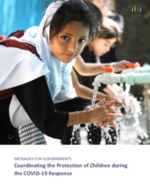
The Child Protection Area of Responsibility (CP AoR) has developed a series of messages calling on governments to take actions to protect children in their COVID-19 responses.
The undersigned organizations of this Call to Action jointly call on the governments of European Union (EU) Member States to immediately commit to the emergency relocation of unaccompanied children from the Greek islands to other European countries, giving precedence to existing family links and the best interests of the child.
The Early Childhood Development Action Network (ECDAN) partners have co-developed and launched a Call For Coordinated Action urging all governments, global partnerships, multi- and bi-lateral agencies, political bodies, funders, international non-governmental organizations, faith-based organizations, the business sector, academia, civil society organizations, networks, and advocates to prioritize and invest in the needs of ALL young children and their parents and caregivers, especially the most vulnerable, during the COVID-19 pandemic response and recovery.
This article argues that child protection agencies must provide mandatory training about the Aboriginal experience within the welfare state and the resultant trauma that exists in Australian Indigenous communities.
This paper presents a participatory research study that explored the experiences of a group of Aboriginal Australian parents who have had their children removed by child protection authorities in one Australian state, New South Wales.
In this interview, Andy Bilson - Emeritus Professor at the University of Central Lancashire, Associate Director of The Centre for Children and Young People’s Participation, and researcher promoting children’s rights and reform of child protection systems - discusses the trends in children's care and protection in the UK and globally over the past few decades.
The goal of the current article is to present this workshop framework and share the free Facilitator’s Toolkit.
In the current article, the cognitive, emotional, mental health, and behavioural benefits of deinstitutionalisation for children with varied disabilities in India and UK are discussed.
This study assesses the present situation of the deinstitutionalisation and alternative care arrangements in exile settlements concerning various cultural and socio-structural factors.
This comparative analysis will illuminate how injustices continue to be reproduced, focusing on the child welfare system, as part of the devastating effects that colonization has on Aboriginal peoples, but also as evidence of colonization being reproduced through current discriminatory legislation and practices.
This paper explores the experiences of Victorian foster and kinship carers accessing timely health assessment and ongoing healthcare for a child placed in their care; identifying barriers and enablers.
This article reflects different programmes and resource components that may be promoted to keep children with either their own family or within alternative family care, satisfying the rights of their overall development.
The authors of this study investigated whether migration background and the gender of the parent who maltreated the child seem associated with the decision whether a case was opened for continuing services.
The purpose of this study was to test the effectiveness and feasibility of a brief trans diagnostic Acceptance and Commitment Therapy (ACT) group intervention for youth with comorbid problems in residential care.
This report surveys different aspects of health of unaccompanied minors who have arrived in the Nordic region.
The aim of this study was to examine the relationship between primary caregiver cognitive impairment (CCI) and child protection system (CPS) investigation outcomes using the Canadian Incidence Study of Reported Child Abuse and Neglect (CIS-2008).
The current exploratory study is the first to look at the challenges and barriers in this transitional life stage of 23 Israeli Arab young adults, from their own perspectives, after leaving residential care.
This paper provides insights into the feasibility and lessons learned from rural Kenya in providing Care for Child Development (CCD) training and supporting its implementation alongside the Baby Friendly Community Initiative (BFCI).
This Guidance Note aims to provide actions to be considered for ensuring gender-based violence (GBV) service provision in the time of COVID-19 with its heightened risks.
This study intended to identify factors associated with receipt of mental health services by caregivers substantiated for maltreatment.
This INEE Guidance Note encourages more intentional and consistent implementation of practical, good-quality psychosocial interventions on the education frontlines by teachers, education administrators, parents, counselors, peers, ministries, and other education personnel.
This module outlines 3 hours (180 minutes) of training activities and materials related to psychosocial support (PSS) and social and emotional learning (SEL) in emergency contexts.
This guide focuses on psychological first aid, which involves humane, supportive and practical help to fellow human beings suffering serious crisis events. It is written for people who can help others experiencing an extremely distressing event.
This manual provides guidance on psychosocial support training in light of the Ebola outbreak in Sierra Leone.
On this webpage, CAFO has created a central place to collect information that might be helpful to members of the faith community as they advocate for children and families in their communities.
This webinar explores guiding principles and practical tips for how your program can protect the children and families you serve during the COVID-19 pandemic.
This report outlines key human rights risks to children related to the COVID-19 crisis, and steps that governments should take to protect children’s rights in the pandemic, mitigate its devastating effects, and benefit children after the crisis is over.
This webpage from the Center on the Developing Child at Harvard University features a list of links to national and international resources that can help with a variety of concerns related to the COVID-19 pandemic.
This webpage from the Center on the Developing Child at Harvard University lists some simple, free activities to help support a child’s healthy development during the COVID-19 crisis.
This correspondence from the Lancet describes the collection of open access online resources for parenting during COVID-19
This report summarises findings from a joint targeted area inspections of ‘the multi-agency response to child sexual abuse in the family environment’ in the UK, which took place between September 2018 and May 2019. The findings in this report consider the extent to which children’s social care, health professionals, youth offending services, the police and probation officers effectively work together to safeguard children who are subject to, or at risk of, sexual abuse in the family environment.
This article from the Lancet reflects on a recent report from the UK Government highlighting the gaps in the multi-agency response to child sexual abuse within the family environment.
This article from the Lancet explores parental migration and its effect on children who are left behind in the context of Sub-Saharan Africa.
This note aims to provide detaining authorities with key information and steps to respond to COVID-19.
This interim guidance is for Long-term care facility (LTCF) managers and corresponding infection prevention and control (IPC) focal persons in LTCF. The objective of this document is to provide guidance on IPC in LTCFs in the context of COVID-19 to 1) prevent COVID-19-virus from entering the facility, 2) prevent COVID-19 from spreading within the facility, and 3) prevent COVID-19 from spreading to outside the facility.
To develop the capacity of Red Cross Red Crescent psychosocial workers to adequately address the PSS needs in the Ebola outbreak, guidance materials and PowerPoint presentations are available here for download, along with a three-day programme to train trainers who are able to further disseminate the PSS knowledge and skills to frontline workers.
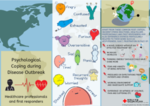
This leaflet offers mental health and psychosocial support messages developed by Hong Kong Red Cross for healthcare professionals and first responders during disease outbreak.
This briefing note provides background knowledge on the MHPSS aspects related to nCoV and suggests MHPSS activities that can be implemented.
This report is for humanitarians working in fragile contexts that are likely to be affected by the COVID-19 crisis. It is organised around broad themes and areas of focus of particular importance to those whose programming advances gender equality and reduces gender inequalities.
This resource describes how the IFSW ethical principles can serve as a compass to guide social workers' deliberations during the COVID-19 crisis.
The resources on this webpage have been collected to support the provision of education in places affected by COVID-19.
In this blog post, the Global Social Service Workforce Alliance describes how the social service workforce is responding to the COVID-19 pandemic and highlights relevant resources and tools.
In this joint statement, 21 global leaders in child protection call for an urgent, united effort to address violence against children as part of the broader response to COVID-19.
This document from the United Nations Office for the Coordination of Humanitarian Affairs (OCHA) outlines the Global Humanitarian Response Plan for COVID-19, a joint effort by members of the Inter-Agency Standing Committee (IASC), including UN, other international organizations and NGOs with a humanitarian mandate, to analyse and respond to the direct public health and indirect immediate humanitarian consequences of the pandemic, particularly on people in countries already facing other crises.