
Displaying 241 - 250 of 859
In this online event, Family for Every Child members FSCE (Ethiopia), The Mulberry Bush (UK), Praajak (India) and CSID (Bangladesh) discussed children's care in the context of COVID-19.

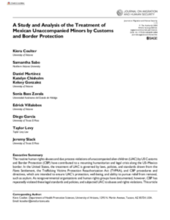
This article draws from surveys of 97 recently deported Mexican unaccompanied alien children (UAC), which examine their experiences with US immigration authorities. The study finds that Mexican UAC are detained in subpar conditions, are routinely not screened for fear of return to their home countries or for human trafficking, and are not sufficiently informed about the deportation process.
The purpose of this study is to evaluate the neglect of left-behind children (LBC) in China.
Based on the life history theory and the interpersonal function model of non-suicidal injury (NSSI), this study aimed to examine the positive impact of loneliness on friendship quality via NSSI among left-behind adolescents.
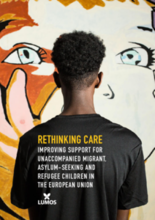
This report maps and assesses the forms of care provided to unaccompanied migrant, asylum-seeking and refugee children in six European Union Member States: Bulgaria, France, Italy, Greece, the Netherlands and Spain.
In this blog post, Anna Riatti - coordinator of the UNICEF Refugee and Migrant Response in Italy - describes how UNICEF is supporting refugee and migrant children in Italy in light of the COVID-19 crisis.
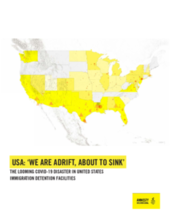
This report from Amnesty International outlines the "reckless response" of U.S. Immigration and Customs Enforcement (ICE) to the COVID-19 crisis, which threatens public health, and calls for the release of immigration detainees.
This document provides programme guidance across numerous migrants and displaced (M&D) children contexts.

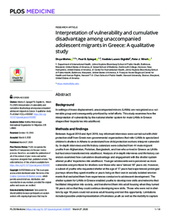
This study examines how the interpretation of vulnerability by the national shelter system for male UAMs in Greece shapes their trajectories into adulthood.
The present research contains two studies: in Study 1 the authors compared prosocial behavior between emerging adults with left-behind experience (EA-LB) and their non-left-behind counterparts; in Study 2, the authors, adopting a sub-sample of Study 1, examined the direct and interactive effects of parental autonomy support, mindfulness, and gender on prosocial behavior in EA-LB.