Displaying 31 - 40 of 537
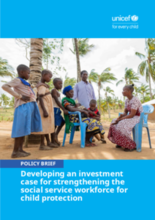
A strong social service workforce (SSW) is the backbone of effective child protection systems. Across Eastern and Southern Africa, social service workers play a critical role in preventing and responding to violence, abuse, neglect, and exploitation of children. Yet, the workforce remains underfunded and understaffed, limiting its ability to deliver essential services. To address this gap, UNICEF Eastern and Southern Africa Regional Office (ESARO) has developed this Policy Brief summarizing the rationale and approach for building an investment case for strengthening the SSW.
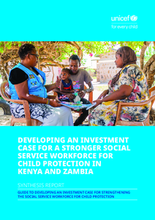
A strong social service workforce (SSW) is the backbone of effective child protection systems. Across Eastern and Southern Africa, social service workers play a critical role in preventing and responding to violence, abuse, neglect, and exploitation of children. Yet, the workforce remains underfunded and understaffed, limiting its ability to deliver essential services. To address this gap, UNICEF Eastern and Southern Africa Regional Office (ESARO) has developed this Synthesis Report , providing a detailed guide to developing an investment case, drawing on lessons from Kenya and Zambia.
This study examines the educational barriers faced by children in institutional care in India, identifying how structural rigidity, limited resources, stigma, and emotional neglect undermine equitable access to meaningful learning. Drawing on qualitative insights from care and education professionals, it highlights the critical role of social work in advancing child-centred, rights-based approaches to transform institutional care into an environment that supports inclusion, wellbeing, and educational equity.
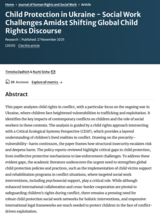
This paper analyzes child rights in conflict, with a particular focus on the ongoing war in Ukraine, where children face heightened vulnerabilities to trafficking and exploitation. It identifies the key impacts of contemporary conflicts on children and the role of social workers in these contexts.
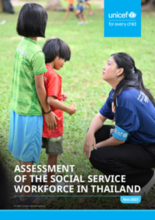
Thailand has a long history of social work and a legal framework recognizing the profession. However, social needs are growing in scale and complexity, while the social service workforce remains under resourced, unevenly distributed, and insufficiently supported. The assessment examined professional social workers, other social service professionals, paraprofessionals, and volunteers across government and non government sectors at national and sub national levels.
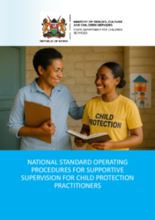
These SOPs aim to strengthen the effectiveness and well-being of Kenya’s child protection practitioners by promoting accountability, continuous learning, and reflective practice. By prioritizing practitioners’ psychosocial health and standardizing supportive supervision across the State Department for Children Services, the guidance seeks to improve service quality, reduce burnout, and enhance outcomes for vulnerable children.
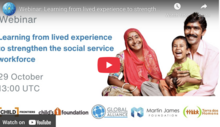
This webinar showcased the learning from Strengthening the Social Service Workforce for Family-Based Care, a two-year project implemented by the Global Social Service Workforce Alliance, with technical support from Child Frontiers, under a grant f
This study examines challenges that hinder social workers in South Africa from providing effective family reunification services, resulting in children staying in alternative care longer than necessary. Findings from a mixed-methods study suggest that providing resources, reducing caseloads, supervising and training social workers, and adhering to reunification principles are key measures to ensure holistic and timely family reunification.
This article examines the socialization and education of orphaned children in Ukraine amid the war, highlighting the psychological trauma, deprivation, and social challenges they face. It calls for reforms in caregiver training, trauma-informed education, and the adoption of a personal paradigm approach that supports each child’s development, resilience, and self-realization.
This paper reviews the challenges faced by unaccompanied and separated migrant children (USMC) in South Africa and the implications for social work practice. It highlights how social workers often lack adequate training and resources to meet the complex, multicultural needs of USMC, emphasizing cross-cultural social work as the most appropriate model for support.