
Displaying 591 - 600 of 616
A template for assessing the suitability of kinship caregivers in the longer term, and for planning the care of a child in kinship care.
Recognition of the crises affecting children and a commitment to improving the lives of children.
A report discussing the advent and perpetuation of institutional care in Central and Eastern Europe and the Former Soviet Union prior to and since the end of the communist regime. It also provides examples of family-based care as models of care to substitute institutional care and offers recommendations to donors, NGOs and governments for child care reform based on their experience in CEE and FSU.
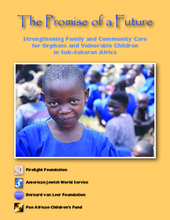
A brief document advocating for the strengthening and support of community based responses to children and families affected by HIV/AIDS in Africa.
Outlines the impact of a pre-pilot conditional cash transfer scheme implemented in Kenya and defines key issues to be considered before moving forward into pilot and national schemes. Short annexes include tools/frameworks to guide implementation.
A series of papers examining kinship care options and programs in the US which address low socio-economic status, culturally appropriate care, exemplary models of kinship care, and public policy.
A manual primarily concerned with the prevention of separation of children during emergencies. It provides a field-oriented guide to solve problems specific to emergency care and tracing and family reunification of babies and children five years and younger.
Collection of articles highlighting suggestions on how to improve existing mechanisms for providing adequate care. Major article on the current state of international thinking on children without parental care.

Assessment of pilot programs employing World Vision Community Care Coalition model in Uganda and Zambia.
This paper examines childcare policy in Mozambique. It finds that vulnerability increases when orphans are placed in resource-poor kinship care arrangements.