Displaying 601 - 610 of 616
A paper outlining the use of formal and informal kinship care, child headed households and cross border kinship care. It discusses the advantages and limitations of each, including welfare costs, and argues for international standard setting.
A brief fact sheet on the multilevel support needs of children without parental care. Includes a brief section on statistical data and examples of UNICEF action in several countries around the world.
This paper presents a set of global policy guidelines for the protection of children without parental care. It recommends the need for a global understanding of best practices within the legal framework of the UN Committee on the Rights of the Child.
A list of US programs and program approaches that influence family reunification outcomes. Relevant for social workers, policy-makers, and others involved in foster care, after care, and family reunification.
Research on the incidence, living arrangements, and causes of lower school enrollment of orphans in Sub-Saharan Africa.
This research paper evaluates the impact of the Child Support Grant in South Africa. It finds that while there exists a strong commitment to implementation, the presence of a child’s mother is an important factor in program participation.
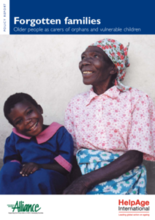
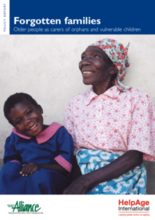
A brief policy report which highlights issues faced by older caregivers of orphans and vulnerable children in Africa. Outlines NGO responses, challenges and recommendations for programmatic support of older caregivers. Includes statistical data on ageing, HIV/AIDS and kinship care in Africa.
This research paper discussed the impact of the South African old-age pension program, or cash transfer, on the health of children living with an eligible recipient. It finds that both gender of the recipient and gender of the child living with the recipient are factors in health outcomes.
A publication by International AIDS Alliance and HelpAge International provides an overview of the issues identified by older people and orphans and vulnerable children themselves; examples of community-based programs that are improving the lives of older people and orphans and vulnerable children; recommendations that will help to prioritize orphans and their carers within HIV/AIDS and wider development policies, programs and research.
This paper describes a qualitative research study conducted in three villages in Malawi. It explores community mobilization and kinship care, as well as striking discrepancies between the perceptions of adults and children regarding care and support. The paper advocates for increased child decision-making, childcare protection policy, and support networks for orphaned children.