Outil d’evaluation pour la transition vers d’autres modeles de protection
Cet outil vise à aider les praticiens à atteindre les objectifs suivants lorsqu'ils fournissent un soutien technique aux institutions en transition :
File
Cet outil vise à aider les praticiens à atteindre les objectifs suivants lorsqu'ils fournissent un soutien technique aux institutions en transition :
This report presents findings from a small-scale qualitative study commissioned by Family for Every Child, examining how kinship care is understood and experienced in Aotearoa New Zealand. It explores the challenges faced by kinship carers and their support needs.
Dieser Beitrag beschäftigt sich mit theologischen und historischen Hintergründen christlichen Engagements für Waisen speziell im deutschen Kontext und stellt wichtige Forschungsergebnisse der letzten Jahrzehnte zum Kindeswohl in Waisenheimen dar. Dabei werden auch gewohnten Denkmuster hinterfragt und Alternativen aufgezeigt, die im besten Interesse der Kinder sind.
This article, by Markus Köker, examines the theological, historical, and practical dimensions of Christian involvement in orphanages, particularly focusing on institutions in the Global South and the support they receive from the Global North. Köker traces how good intentions, religious motivations, and volunteer tourism have sustained orphanage systems that often harm children’s development and perpetuate family separation.
Changing the Way We Care (CTWWC) is a global initiative which promotes safe, nurturing family care for children. Since 2018, the focus has been on the reform of national systems of care for children, grounded in demonstration country work in Guatemala, India, Kenya and Moldova.
Street-connected children in Ghana face systemic marginalization, requiring comprehensive interventions at the family, community, and policy levels. Based on insights from 12 social workers, this study highlights micro-, mezzo-, and macro-level strategies to reduce the number of street-connected children and support their reintegration into society.

Italy and Türkiye, both key transit countries for unaccompanied children, have legal frameworks to support them, yet gaps between policy and practice hinder access to services and a smooth transition to adulthood. This study, based on qualitative fieldwork and 23 interviews conducted in both countries, examines reception systems, accommodation services, and the challenges unaccompanied children face during this critical life stage.
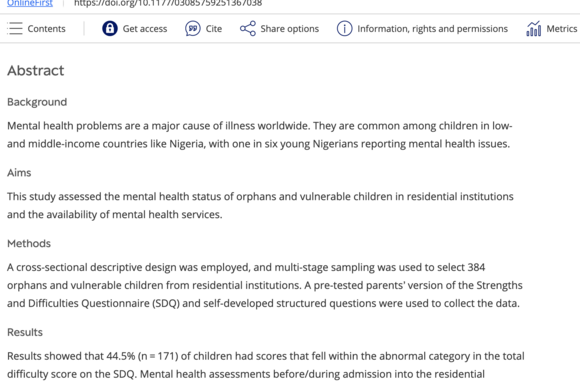
This study assessed the mental health of children in 12 Nigerian residential institutions and found that many had abnormal scores on the Strengths and Difficulties Questionnaire, with risks linked to orphan status, type of institution, and length of stay. The findings highlight the urgent need for routine mental health assessments and better care for children in residential settings.
This book unveils unique research on the transformative power of listening to children, exploring how they navigate family life and relationships. It offers fresh insights for theories, policies and practices in support of children’s welfare.
This study explored the experiences of 11 young mothers in Western Australia with out-of-home care (OHC) backgrounds, highlighting that leaving care planning and post-care support often failed to meet their needs, particularly around parenting. Participants felt underprepared and under-supported, but expressed determination to break cycles of OHC, pointing to the need for improved services and future research.