This section includes resources on the response to the COVID-19 pandemic as it relates to child protection and children's care.
News on COVID-19 and Children's Care
Webinars and Events on COVID-19 Response
Displaying 561 - 570 of 759
This document aims to guide the revision of existing Standard Operating Procedures (SOPs) for Food Distribution in the COVID-19 context at the country level to minimize the risk of exposure of personnel, partners and beneficiaries.
This guidance is to support the management of children and young people living in children's homes, residential special schools and colleges, and other residential facilities during the COVID-19 crisis.
This interim guidance is for Long-term care facility (LTCF) managers and corresponding infection prevention and control (IPC) focal persons in LTCF. The objective of this document is to provide guidance on IPC in LTCFs in the context of COVID-19 to 1) prevent COVID-19-virus from entering the facility, 2) prevent COVID-19 from spreading within the facility, and 3) prevent COVID-19 from spreading to outside the facility.
UNAIDS has consulted with the HIV and Human Rights Reference Group, experts from civil society, academia and public health and other United Nations agencies to identify key learnings from the HIV response that are critical in ensuring an evidence-informed and effective response to an epidemic.
This framework represents Save the Children’s planning assumptions and priority areas for implementation over four phases of programming: Preparedness, Initial Response, Large-Scare Response, and Recovery.
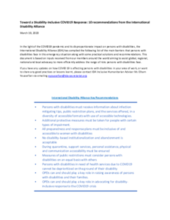
In the light of the COVID19 pandemic and its disproportionate impact on persons with disabilities, the International Disability Alliance (IDA) has compiled the following list of the main barriers that persons with disabilities face in this emergency situation along with some practical solutions and recommendations.
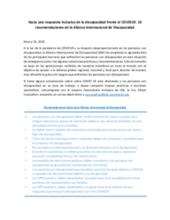
A la luz de la pandemia de COVID19 y su impacto desproporcionado en las personas con discapacidad, la Alianza Internacional de Discapacidad (IDA) ha compilado la siguiente lista de las principales barreras que enfrentan las personas con discapacidad en esta situación de emergencia junto con algunas soluciones prácticas y recomendaciones.
In this webinar, veteran online instructors help identify steps to move online and strategies for adapting the lessons already in motion to this new format.
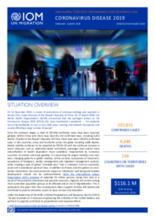
This appeal seeks to respond to additional needs which have emerged, or may do so in the short and medium term, in national contexts currently affected by humanitarian situations, as well as those that present more stable environments yet are equally vulnerable to the global pandemic, due to ill-prepared health systems and assistance mechanisms to respond at scale.
This guidance provides an overview of the risks associated with COVID-19 outbreak that could cause children to be left without appropriate parental care, and provides scenarios for where children may be identified as separated in Iraq due to issues related to COVID-19.