
الحملة العالمية لإصلاح رعاية الأطفال: لمحة عامة
File
This document has been developed to support those engaging technically with the Global Campaign of Children’s Care Reform by providing a deeper exploration of key themes introduced in the Global Charter on Children’s Care Reform. This document offers elaboration and practical insight into several of the central themes reflected in the Global Charter. It draws on the global evidence base, links to foundational guidance and standards, and incorporates the experience and expertise of those with lived experience of care, technical experts, and practitioners.
The document presents Ukraine’s ongoing child protection reform, known as the Better Care for Every Child initiative, which focuses on shifting from institutional to family- and community-based care. It outlines the key priorities of the National Strategy on Deinstitutionalization, including early identification of vulnerabilities, family support services, inclusive education, and the development of quality alternative care.
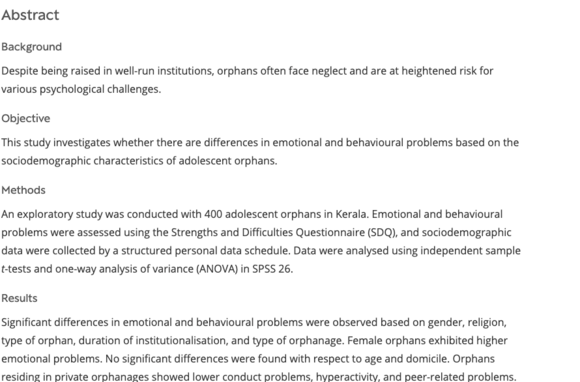
This study examined differences in emotional and behavioural problems among 400 adolescent orphans in Kerala, India using the Strengths and Difficulties Questionnaire to assess how sociodemographic factors shape mental health outcomes. The findings revealed significant variations by gender, religion, type of orphanhood, length and type of institutional care, underscoring the need for tailored psychosocial interventions that reflect these differences.
This study examined the relationship between disability type and service receipt among U.S. transition-age youth aging out of foster care, a population in which 53% have a diagnosed disability, across all U.S. states, Washington, DC, and Puerto Rico.
This study examines how children with unknown parentage are cared for in modern society and the societal risks they face, using analysis of existing research. It finds that factors such as religious beliefs, economic conditions, and post-birth abandonment—along with stigma and discrimination—significantly shape these children’s experiences, and calls for stronger reforms and increased investment in child welfare programs.
The Kusamala+ Stigma Reduction Toolkit is the product of a 10-year community based program in Zambia to reduce stigma for children with disabilities living in family-based care in low-income compounds and improve family quality of life
This resource presents a costed policy study on investing in disability-inclusive and gender-responsive community care and support systems across the life cycle in Kenya, developed by the Ministry of Labour and Social Protection.
This chapter in the The Routledge Handbook of Social Work and Migration focuses on social work with children and young people who have experienced forced migration and become separated from family members, known as unaccompanied minors. It explores the possibilities of rights-based practice with unaccompanied children and considers what might be needed to develop and sustain this.
Supporting parents and caregivers requires a whole-of-society approach, with coordinated responses from the health, education, social services, private and other sectors. This brief focuses on the role of the health sector specifically. It explains why the health sector should support parents and caregivers, describes the type of support they need, and outlines the key building blocks of the health sector response.
