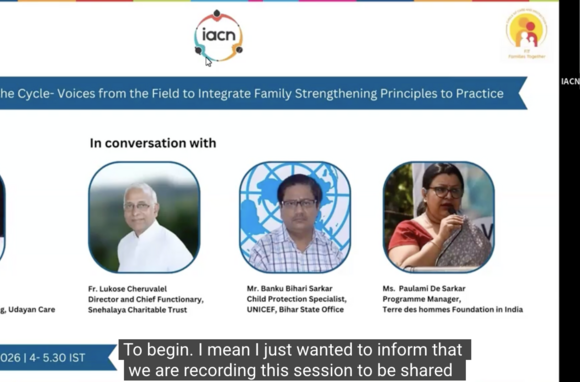
[Webinar Recording] Child Protection in the Era of Localization: Context, voice, and ownership

CPC Learning Network

This webinar, co-hosted by the Columbia University Seminar on Global Mental Health, examined how the shift toward localization is reshaping community-based child protection. The session explored both the challenges and opportunities of localizing child protection and well-being initiatives, emphasizing the need to transfer power to communities and support genuine local ownership for sustainable impact.

So Goes China: The End of Intercountry Adoption as We Know It?

Kristen E. Cheney and Karen S. Rotabi-Casares

This article presents a brief history of intercountry adoptions from China and other countries, discusses reasons for its demise, and considers the consequences—for China’s children and for intercountry adoptions more broadly. It questions whether we are indeed seeing the end of intercountry adoption “as we know it,” while recognizing the emergence of new systems of care.

Image
Image of article

‘If We Do Not Speak Out, No One Else Will’: Adoptee Activism and Its Impact on Intercountry Adoption in The Netherlands

Shila Khuki de Vries, Sarah Janaki Peshala de Vos, and Kristen E. Cheney

This article highlights the role of adoptee activism in raising awareness and changing policy regarding Intercountry Adoption (ICA) in The Netherlands. Through interviews with a selection of adoptees engaged in activism, this study shows that adoptees became engaged in activism as a result of growing adoptee consciousness in combination with encountering irreconciliation; they employed many types of activism, sometimes with different goals and strategies; they cooperated in different constellations and with many allies such as journalists, lawyers and scholars; and their activism had significant impact on general awareness and government policy.

File

[Video] Global Charter on Children’s Care Reform: Guidance for Requesting Technical Assistance

Maestral International

This video provides a short overview of the Global Charter on Children's Care Reform:Guidance for Requesting Technical Assistance, which provides instructions on how governments can request technical support from a team of care reform advisors to develop or begin implementing those commitments. This includes a description of the different types of technical assistance available, ways it can be provided, and a step-by-step guidance for submitting requests.

[Video] Global Charter on Children's Care Reform: Guidance for Developing Commitments

Maestral International

This video provides a short overview of the Global Charter on Children's Care Reform: Guidance for Developing Commitments, which supports governments to design ambitious, measurable, and context-specific commitments that align with the Charter’s principles. It includes practical criteria, examples, and participatory approaches to ensure commitments are realistic, well-resourced, and responsive to children’s needs. 

Shifting U.S. Christian Support in Global Orphan Care: Learning and Strategy Session

Faith to Action

This webinar presented findings from a 2025 Media Landscape Analysis by Pinkston and Barna’s 2025 survey of U.S. Christians, highlighting a significant shift in Christian media narratives away from orphanages and toward family-based care, alongside rising awareness that poverty—not orphanhood—drives most placements.

Alone, On the Move and Unseen: Spotlighting the urgent needs of unaccompanied and separated children

International Data Alliance for Children on the Move (IDAC)

This brief by the International Data Alliance for Children on the Move (IDAC) calls for urgent global action to close these data gaps and strengthen evidence-based policies that uphold the rights of unaccompanied and separated children. Based on a 2025 literature review of more than 200 sources, it identifies key trends by age, gender, migration status and route, and other variables.

File

Webinar Recording: Strengthening  Children’s Care Reforms through Access to Justice

Better Care Network, Child Identity Protection (CHIP), Institute for Inspiring Children's Futures, UK Foreign, Commonwealth and Development Office, Pathfinders for Peaceful, Just and Inclusive Societies & UNICEF

This webinar, held December 16, 2025, spotlighted the powerful intersection between two consequential global advocacy movements in human rights: the reform of alternative care systems for children and the advancement of children’s access to justice.

Transition Case Study: Alliance For Children Everywhere Zambia

Better Care Network, ACE Zambia

ACE Zambia, founded in 1998 as a faith-based organization supporting orphans and vulnerable children, gradually shifted from operating multiple residential care facilities toward strengthening family- and community-based services after recognizing the harms of long-term institutionalization. Between 2014 and 2025, the organization closed all residential homes, expanded preventative and family-focused programs, and ultimately increased its reach by supporting far more children in safe family settings using the same level of resources.

File

Assessing the impacts on child welfare practice of important articles of the UN convention on the rights of the child: A comparison of Australia, Canada and the USA

Bob Lonne, Ashley Stewart-Tufescu, Shawna Lee, and Christine Morley

The 1989 Convention on the Rights of the Child (CRC) affirms the importance of family, culture, and community in children’s lives and obligates governments to support families and protect children from discrimination, violence, and exploitation, yet many countries still lack policies that require a child-rights approach, prioritize best interests in decision-making, or prohibit corporal punishment. This article critically examines how effectively Australia, Canada, and the United States have implemented key CRC principles—particularly best interests and corporal punishment—by comparing their child protection policies, legislation, and practices to assess the Convention’s influence and its potential to drive broader system reform.

File