
Displaying 221 - 230 of 235
Brief article arguing for doctors to take a lead role in caring for children on the street. Suggests that physicians could provide direct patient care, advocacy for children's rights, and leadership for reform at the community and national level.
Highlights the work of Childhope Asia Philippines and Families and Children for Empowerment and Development in helping street children living in and around Manila.
An analysis of the multi-level factors present in the lives of children living and working on the streets. The author advocates for integrating human rights and child participation based approaches into interventions and supports for at-risk children.
Examines the emergence of children living and working on the streets in China. Disaggregates 'street children' as a phenomenon by outlining the underlying causes for their situations. Compares adult perceptions of 'street children' with the children's own perspectives.
An account of the massive child welfare crisis in Romania which erupted from a movement in Romania during its communist regime to institutionalize thousands of children. This paper also reports the efforts of NGO’s, PVO’s and the international communities to reverse the damage after the fall of communism and also where the efforts need to be directed.
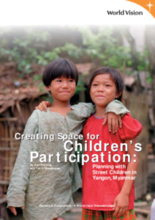
Summarizes an empowerment evaluation of the Street and Working Children Program in Yangon and Mandalay. Includes detailed methodology and lessons learned.
Country report of China on the situation of children in residential care in anticipation of the Second International Conference on Children and Residential Care: New Strategies for a New Millennium, to be held in Stockholm 12 – 15 May 2003.
Report from a regional meeting on street children in South Asia. Contains country reports, outlines key issues, and highlights best practices for programs operating in the region. Includes recommendations for advocacy, program and policy development.
Examines initiatives taken to protect street children in Africa. Emphasis on increasing community and NGO participation in local responses.
A summary of strategies to prevent the migration of children to the streets as presented at a 1999 conference in Ireland.