
File
Displaying 191 - 200 of 344
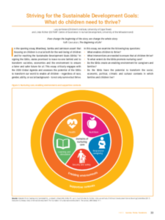
This essay critically engages with the 2030 Global Agenda and assesses the potential of the SDGs to transform our world to enable all children – regardless of race, gender, ability, or social background – to not only survive but thrive.
This paper adopts a qualitative case study on the generalist service delivery model of I‐Care, a Durban‐based non‐governmental organization that works with male street children.
This article draws on data from the only longitudinal study on care-leaving in South Africa. It uses resilience theory to explain the differences observed in independent living outcomes of care-leavers, one year after leaving the residential care of Girls and Boys Town.
This article describes the 1‐year outcomes of youth transitioning out of a residential care facility in South Africa.
This article describes the 1‐year outcomes of youth transitioning out of a residential care facility in South Africa.
High numbers of children in kinship care in South Africa are putting a strain on the foster care system due to the intensive supervision required in order for families to receive the Foster Care Grant.
This qualitative study explores 49 orphaned children who were observed in a non-governmental organization group setting in a small, rural village located in Eastern Cape, South Africa.
This study is the first randomized controlled trial design to rigorously test the effectiveness of a parenting program on reducing the risk of child maltreatment in sub-Saharan Africa using both observational and self-report assessments.
A Kinship Care Grant has been proposed in South Africa due to a strained child protection system in the country.
This qualitative study investigates how a sample of male care-leavers from Girls and Boys Town South Africa transferred these social skills into independent living.