
File
Displaying 951 - 960 of 1206
Children and Families Across Borders (CFAB) describes a new research venture to identify and share examples of best practice regarding social work cases that cross international borders.
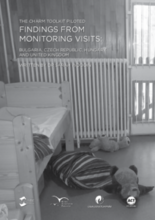
This report is one of several outputs arising from the project “Identifying and Preventing Abuse of Children with Mental Disabilities in Institutions.” The report presents findings from the monitoring of European institutions where children with intellectual disabilities and children with psychosocial disabilities live on a permanent or semi-permanent basis, through the development of tools and guidance aligned with international human rights law and policy.
This guide from Coram Voice in the UK provides guidance to youth leaving or aging out of the foster care system, including informing care-leavers of their rights.

This paper presents the process and the outcomes of a participatory action research project with a group of unaccompanied asylum seeking young people living in foster care.
Alex Renton discusses his book Stiff Upper Lip, which documents the years of physical abuse he endured while attending boarding school.
This Act was enacted by the government of the United Kingdom "to make provision about looked after children; to make other provision in relation to the welfare of children; and to make provision about the regulation of social workers."
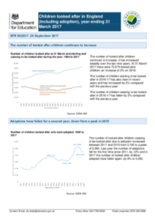
This Statistical First Release (SFR) provides information about looked after children in England for the year ending 31 March 2017, including where they are placed, their legal status, the numbers starting and ceasing to be looked after, and the numbers who go missing or are away from their placement without authorisation.
This article from BBC reports that late family interventions are forcing children into care.
People protest as Britain reneges on its duty to take in 3,000 refugee children.
The best thing people can do to help change the perception of children in care is to speak to, read about, and listen to people who have experienced care.